An old bowl can be easy to replace until it lives in a fitted stand, feeder, or travel carrier. Then a few millimetres and a different wall angle can matter more than stated capacity. The replacement must be supported correctly and remain removable without force.
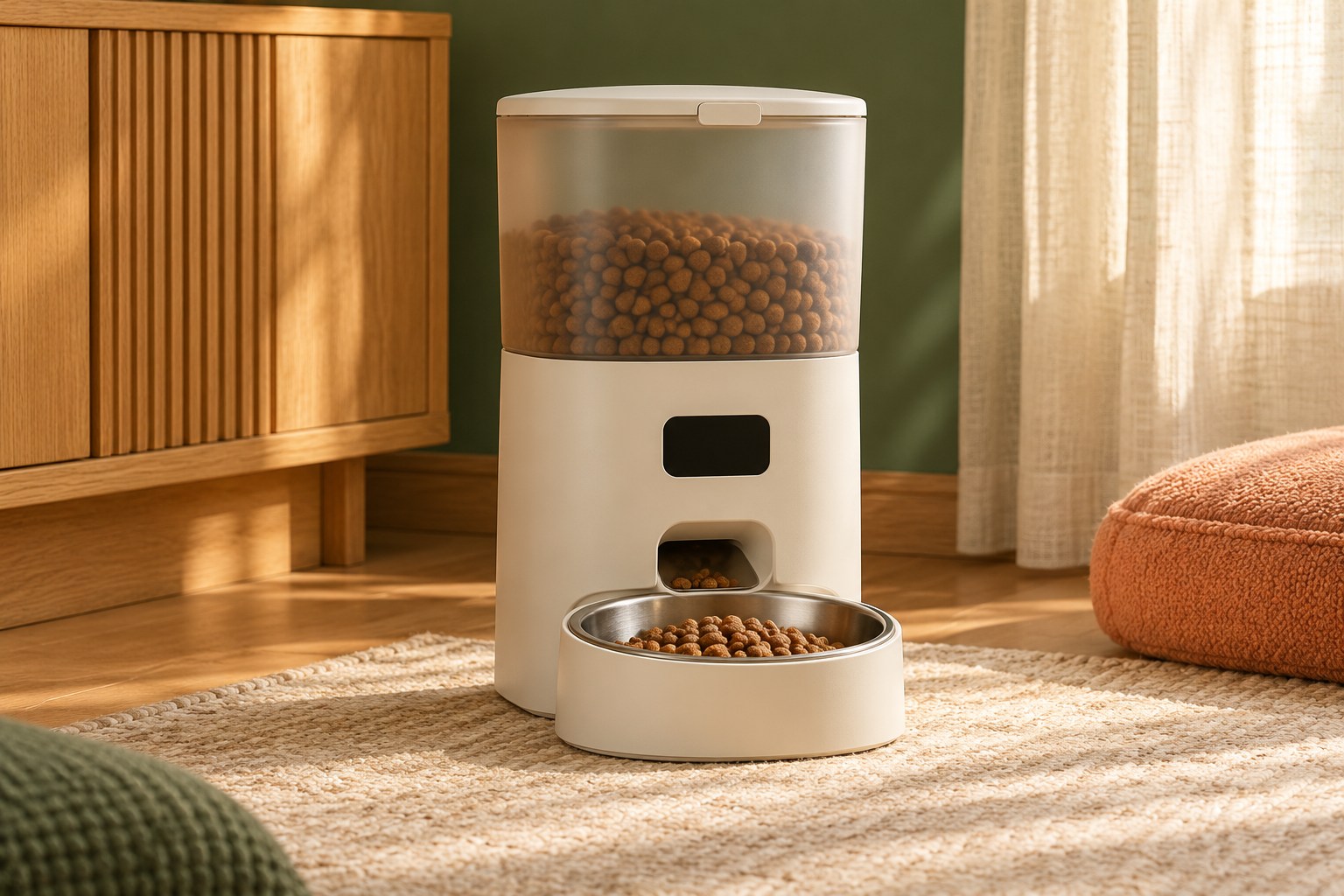
Before shopping, check whether the original manufacturer offers the exact spare. That is often the simplest route, especially for powered feeders whose bowls sit beside outlets or sensors. If an alternative is permitted, measure the complete fit rather than ordering by a familiar-looking photograph.
Record four useful dimensions
Measure the outer rim diameter, opening diameter, body diameter at the support height, and overall depth. For an oval or rectangular bowl, record both axes and corner shape. A rounded rectangle and a squared rectangle can share headline measurements while fitting differently.
Write the measurements beside a simple sketch. Note any tabs, notches, rolled edges, or flat areas that locate the insert. Photographs with a ruler can supplement the sketch but should not replace measurements, because perspective makes small differences hard to judge.
Identify the actual support surface
Some bowls hang from a rim; others rest on their base inside a recess. A hanging insert needs a sufficiently broad lip. A base-supported insert needs the correct depth and a flat seating area. Mixing the two arrangements can leave a bowl rocking or trapped.
Look for marks showing where the old bowl contacted the holder. If it sat on a ring, measure that ring too. Do not assume the top opening is the relevant dimension when the frame supports the bowl several centimetres below the rim.
Account for removal and cleaning
A replacement that fits tightly when dry may be difficult to lift with wet hands. Preserve finger clearance or the holder's intended lifting notch. Check that the insert can rise straight out without catching the feeder outlet, wall, or shelf above it.
For a hypothetical stand with a 14-centimetre support opening, a bowl with a 14-centimetre outer rim might fall through, while one with a broad 16-centimetre rim may be supported. The body shape still needs checking; the larger rim alone does not establish compatibility.
Compare material and weight
A heavier insert changes the load on the holder and may behave differently if the pet pushes it. Follow any material or compatibility restrictions for the product. In a powered feeder, avoid substitutions that obstruct the outlet or interfere with a sensor or moving cover.
Check care instructions for the new bowl and any included rubber parts. A change from steel to ceramic may alter both washing and handling. Keep the original insert available until you have verified the replacement's complete fit and safe normal operation.
Confirm before filling
Seat the empty replacement and check for rocking, gaps, excessive pressure, or a rim that lifts on one side. Remove it again to ensure access is straightforward. If the fit depends on bending the holder or adding makeshift packing, use another bowl.
Retain the successful replacement's model number and dimensions with the equipment record. The next purchase becomes easier when it starts from a verified specification rather than another search through visually similar listings.
For our approach to product claims and illustrations, see the Editorial Policy.