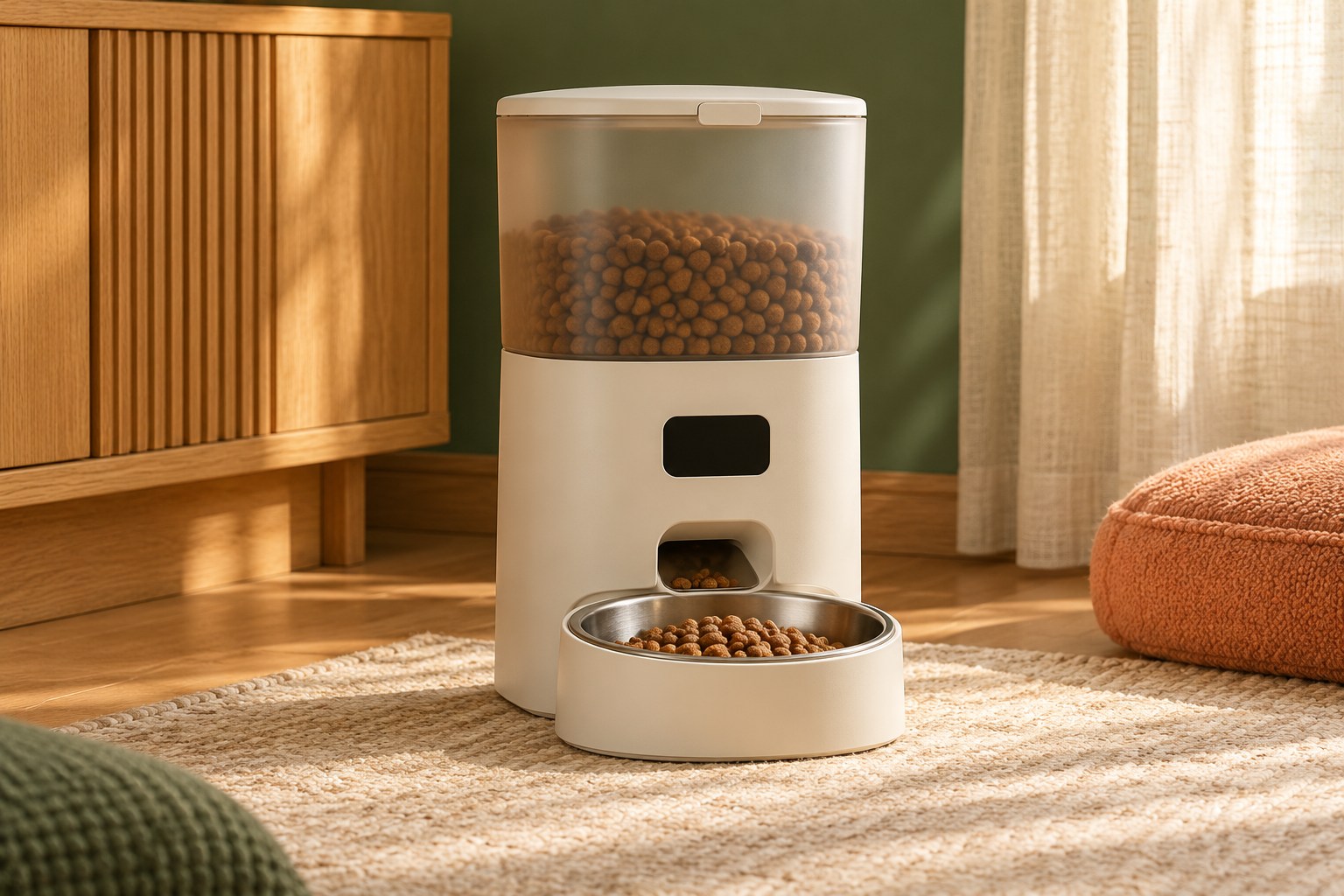
An automatic feeder's display might offer portions numbered from one upward without explaining what each number means in your kitchen. The mechanism usually releases food in discrete movements. The amount delivered can change with the size and shape of the food, so the machine needs a practical check before you rely on its schedule.
Set the desired serving amount separately, using the guidance already appropriate for your pet. Calibration is about matching the dispenser to that amount; it is not a way to decide how much the animal should eat.
Find the usable operating range
Read which food sizes and types the manufacturer permits. A feeder designed for dry pieces may not handle soft or irregular material. Avoid testing an unsuitable food simply because it fits through the hopper opening; internal passages and moving parts may be smaller.
Inspect the outlet and any removable rotor before filling the hopper. Confirm that everything is fitted correctly and that the collection bowl sits beneath the discharge path. Use a level surface so each trial starts from the same physical setup.
Measure several deliveries
Place an empty dish on a suitable kitchen scale and zero it. Trigger one chosen setting manually, weigh the result, then repeat in a clean dish several times. Record individual results as well as their average so you can see whether variation is small or substantial.
For example, five hypothetical deliveries of 18, 20, 19, 18, and 20 grams average 19 grams. That does not mean every future serving will be exactly 19 grams. If the desired amount falls between available settings, consider whether the feeder's increments are precise enough for your intended use.
Repeat when important inputs change
Changing food shape, replacing a dispensing part, or discovering an unusual result is a reason to recalibrate. Do not assume an old setting carries across a different product. Label the record with the feeder model, food identification, date, and relevant setting.
Check performance with the hopper at different permitted fill levels. Keep food above the stated minimum and below the maximum. A test that works only when the hopper is completely full does not establish how the machine behaves through an ordinary refill cycle.
Confirm delivery rather than the display
An app notification may confirm that a command ran, but it does not always prove the food reached the bowl. Observe several scheduled runs while you are home. Look for bridging in the hopper, pieces caught at the outlet, or a bowl displaced by the pet.
Keep an ordinary serving method available during setup and whenever the machine needs maintenance. Record the final schedule in plain language beside the numeric settings so another household member can understand what the feeder is intended to do.
Keep averages from hiding an unsuitable increment
A useful calibration record includes the smallest supported setting and how additional settings change delivery. Do not assume that setting two is exactly twice setting one. The device may use a particular release sequence, and food can settle differently between movements. Measure the settings you actually intend to use rather than extrapolating from a single test.
Imagine a desired serving that lies between two repeatable outputs, 34 grams and 43 grams. Averaging those numbers does not create an available 38.5-gram setting. If the equipment cannot match the intended routine within an acceptable range established for the pet, use another serving method or seek individual guidance about the plan. Avoid inventing alternating schedules merely to make a machine appear precise.
Track a complete refill cycle
A first test at maximum fill is useful but incomplete. Over several supervised days, note the hopper level, measured deliveries, and whether pieces collect above the outlet. Follow minimum-fill instructions throughout. If the mechanism releases inconsistently near the lower permitted level, document the result and consult support instead of silently adjusting the schedule to compensate.
Keep the measurement dish separate from the ordinary serving bowl during checks so leftover pieces do not distort the result. If someone else completes a trial, give them the same zeroing and weighing steps. A small record with individual results, not just a rounded average, makes genuine changes easier to distinguish from differences in testing technique.
Recognise when calibration is not the solution
Measurement can reveal a problem without providing a setting that fixes it. Large swings between repeated deliveries, persistent bridging, or food falling after the motor stops may indicate an unsuitable food size, assembly issue, or faulty component. Follow the troubleshooting procedure and contact support when needed. Do not hide those results by reporting only a rounded average.
Consider a hypothetical feeder producing 12, 27, 14, 29, and 13 grams at one setting. Its average is nineteen grams, but that summary misses the large differences between servings. A different model producing 18, 19, 20, 18, and 20 grams has a similar average with a very different pattern. Whether either is appropriate depends on the intended plan, but the first clearly needs investigation before routine use. Calibration is a diagnostic step as well as a setup task.
For our approach to product claims and illustrations, see the Editorial Policy.