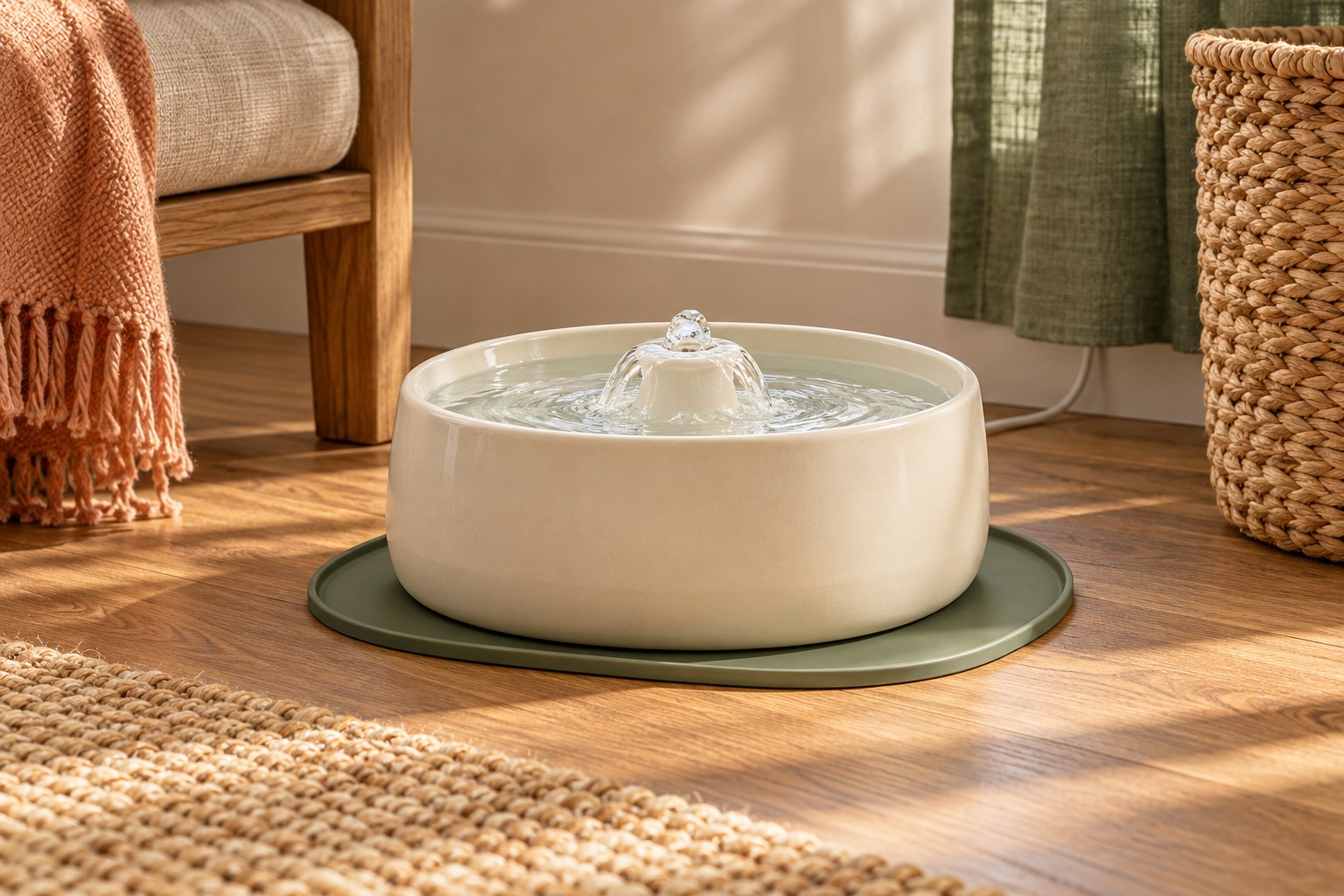
A low purchase price can make a fountain seem economical until replacement filters become difficult to identify or expensive to obtain. The relevant cost is the complete system over time: the fountain, compatible consumables, replaceable pump parts, and the cleaning routine it requires.
Filter terminology is not always consistent between brands. Rather than comparing broad claims, start with the exact cartridge specified in the manual and the replacement guidance for that model. Keep water treatment claims separate from the practical question of keeping equipment clean.
Identify every consumable
Some fountains use one cartridge; others add a foam sleeve, separate prefilter, or gasket that wears during disassembly. Make a list of all parts the manufacturer expects an owner to replace. Record package quantity as well as price so a multipack does not distort the comparison.
Check whether the model number on the replacement listing matches the fountain precisely. A cartridge that nearly fits can leave gaps or interfere with the lid. Product photographs alone may not reveal a small change in thickness between generations of the same design.
Turn schedules into a comparison
Use the manufacturer's replacement guidance as the starting assumption, then calculate the number of packs needed for a year. If a hypothetical cartridge costs three dollars and the schedule requires twelve, the annual cartridge cost is thirty-six dollars before any other parts.
This is a budgeting example, not a universal replacement interval. Actual instructions and operating conditions differ. Compare fountains using equivalent assumptions, and note any shipping threshold that makes small replacement orders disproportionately costly. A locally stocked cartridge may be more convenient than a cheaper obscure one.
Keep filtering separate from washing
A cartridge does not reach residue on the basin, inside a spout, or behind a pump cover. Follow the fountain's cleaning instructions for those surfaces regardless of how recently a filter was replaced. A calendar entry for consumables should not become the entire maintenance plan.
Check whether cartridges need preparation before installation and how they should be positioned. Do not invent a rinsing, soaking, or reuse method that conflicts with the product instructions. Used disposable components should be replaced as directed rather than stretched indefinitely to make the budget look better.
Consider availability as a design feature
Before purchasing, look for a clear replacement-parts page and distinguish a current product from a discontinued model. A fountain with proprietary parts may still be a sensible choice when the maker supports it consistently. Standard-looking shapes do not guarantee interchangeability.
Store the model details and a photograph of the correct package together. If the fountain is shared between household members, label the spare supply clearly. Keeping the wrong cartridge in the cupboard creates a maintenance delay even when everyone believes replacements are ready.
Compare support costs with a simple scenario
Suppose two hypothetical fountains cost the same initially. Model A uses a cartridge sold in clearly labelled six-packs and offers a separately listed pump. Model B uses an inexpensive cartridge whose listing does not identify the supported generation. The second option may appear cheaper, yet uncertainty creates the risk of ordering unusable stock. A slightly higher known cost can be easier to manage than an ambiguous supply.
Ask whether replacement parts can be ordered without buying a complete new fountain. Record shipping cost and expected availability alongside cartridge price. Do not buy a large speculative supply before verifying compatibility with the actual unit. Once you have confirmed the fit, a modest spare quantity can prevent rushed substitutions when routine replacement is due.
For our approach to product claims and illustrations, see the Editorial Policy.