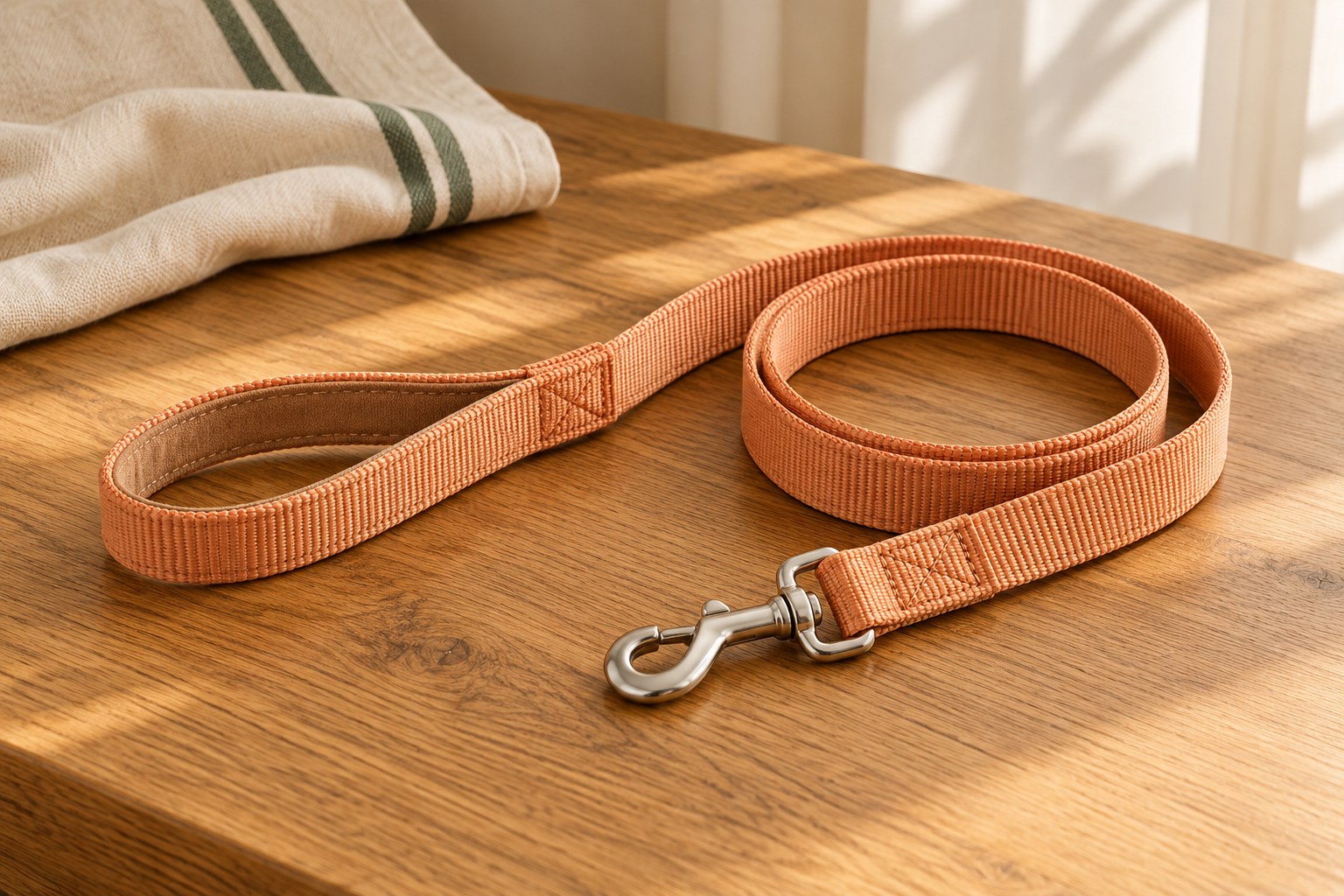
Coated-webbing leashes have a textile core covered by a smoother outer layer. Mud often wipes off more easily than it does from woven fabric, which makes the style appealing for wet paths. The tradeoff is feel: some coatings are supple and grippy, while others become stiff or slippery in particular conditions.
The surface is only one part of the product. Holes, rivets, seams, and the clip remain working components that need inspection.
Try the bend and grip
Fold the leash as you would when gathering extra length beside a road. A very stiff strip can spring back or create an awkward stack in the hand. A tacky surface may grip well barehanded but drag against gloves; a smooth finish may be easier to wipe yet harder to hold when wet. If possible, compare the product at the temperature in which you will use it. Do not assume a material’s indoor showroom feel will describe a cold morning walk.
Look closely at the edges
The coating should cover the webbing evenly without lifted sections or obvious cuts. Pay attention around punched holes and the end folded around the clip, where movement concentrates. Some products use rivets, screws, stitching, or combinations of these. Follow the maker’s maintenance guidance rather than tightening or replacing fittings with random hardware. A loose rivet or splitting edge is a reason to stop using the leash until the manufacturer provides a suitable resolution.
Choose hardware for the environment
A smooth leash body does not prevent a metal gate from collecting grit or corroding. Open and release the clip several times while unloaded, checking that it returns fully closed. Keep hair and sand away from the hinge. Rinse after exposure to saltwater if the care instructions permit it, then dry the hardware separately from the coiled strip. Avoid interpreting a marketing term such as waterproof as a promise that every attached component needs no attention.
Keep its limitations visible
Coated webbing is not chew-proof. Tooth marks, deep scoring, exposed textile, and cracks change the condition of the leash even if the outer surface still wipes clean. Do not leave a dog tethered unattended with it. For a hypothetical muddy field walk, a short rinse may restore the surface, but a visual check along both sides is still necessary before the next outing. Store it loosely rather than forcing a tight crease around the same point every day.
Decide whether wiping actually saves work
Imagine a route with muddy grass followed by a clean paved stretch. A smooth coating may let you wipe the leash before gathering it into your hand or placing it in a bag. On a sandy beach, however, the clip and any punched holes still need attention, and grit can scratch the surface. The benefit is specific to the kind of dirt you encounter, not a promise that all maintenance disappears.
Compare storage as well. A stiff coated leash may occupy more space than soft webbing and resist a tight coil. If your walking bag has a narrow compartment, try folding the unloaded leash into it without forcing sharp creases. Keep a damp leash away from electronics even when its surface feels easy to dry. A breathable temporary compartment is useful for transport, but open the leash out at home so moisture around hardware can escape.
If the coating remains clean but the joins are difficult to inspect, choose another design. Accessible edges and visible fasteners make the product easier to assess through its working life than a flawless-looking outer strip alone.
For our approach to product claims and illustrations, see the Editorial Policy.