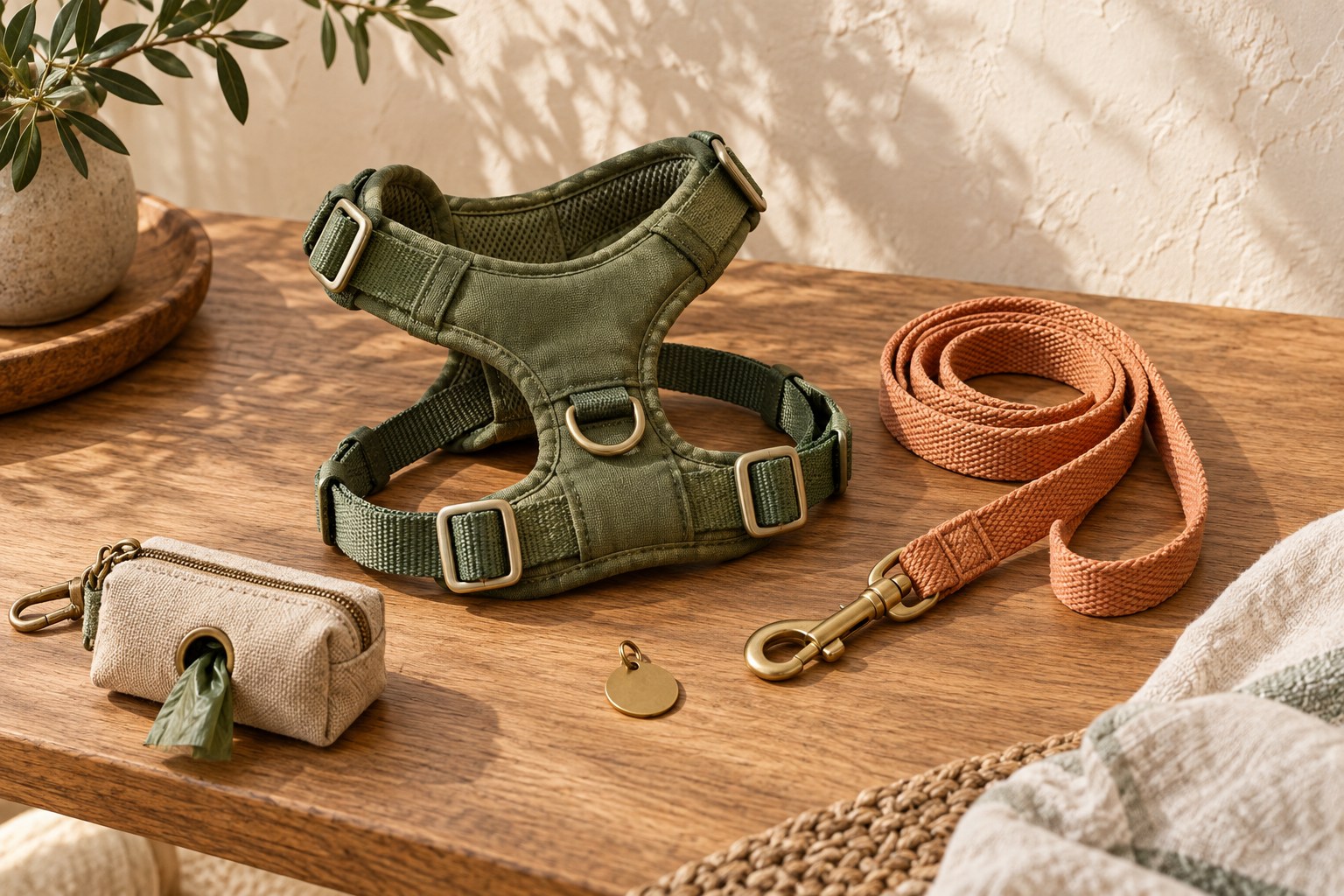
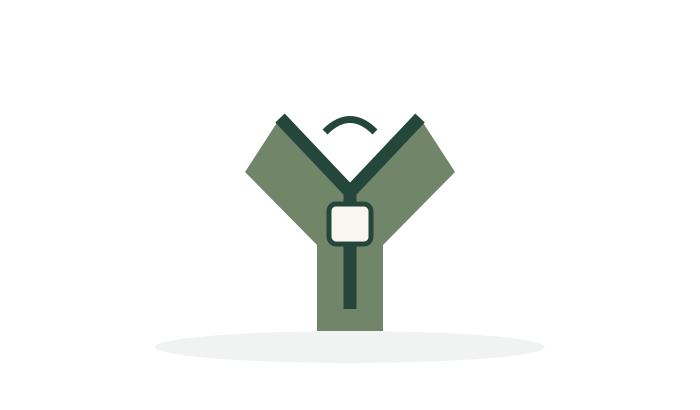
Some dogs find a harness approaching their head uncomfortable, while their owners find multiple straps difficult to untangle. A step-in design can simplify that routine: the front feet enter two openings and the harness closes above the back. The practical benefit depends on whether the dog will calmly place each foot and whether the finished harness fits its chest.
Treat ease of dressing and security of fit as separate questions.
Choose a leg-opening pattern deliberately
Two products labeled step-in can distribute pressure quite differently. A lightweight strap version may have almost no chest coverage; a vest version may spread contact across a broader area but retain more heat. Look at the edge nearest each elbow, especially when the dog sits. A rigid seam that seems harmless while standing can push into a leg fold. For a hypothetical short-legged dog with a wide chest, broad openings may work better than deep, narrow openings cut for a taller build.
Understand what closes the harness
Some designs fasten with a buckle, some use hook-and-loop material plus a buckle, and others depend on the leash clip joining two rings. Read the actual fastening instructions before the first outing. If two rings must be captured, practice doing that consistently in good light. Hook-and-loop patches lose grip when packed with fur, and a buckle should close with both sides fully engaged. Decorative trim should never make the working closure difficult to see or reach.
Build a calm dressing sequence
Lay the harness flat in its intended orientation. Invite one foot into each opening using a reward or a familiar station cue, then lift the sides without dragging straps across the toes. Rehearse for a few seconds indoors and remove it before frustration builds. A dog that repeatedly lifts its feet out may need a different approach, not firmer restraint. If lowering hands near the paws causes distress, an overhead harness with a neck buckle may actually be easier.
Judge the fit with ordinary movements
Once fastened, inspect the underside rather than relying on how neat the back looks. Watch the dog lower its head, sit, and take several steps. The fabric should not bunch against the throat or pull a foreleg inward. Test leash handling gently in a secure space and look for the harness rising excessively toward the head. Recheck adjustments when a winter coat is added or removed; extra clothing changes the circumference and can also make smooth fabric slide more readily.
Compare an open strap design with a vest
Suppose a dog calmly places its feet but dislikes fabric being pulled high around the chest. An open strap version may reduce that contact, though the owner must keep the loops correctly oriented. Another dog may find a soft vest easier because its two leg openings are obvious and the back closure is simple. Neither response can be predicted from body size alone.
Lay both designs flat and trace the fastening sequence before fitting. Count how many actions happen while the dog must remain still: foot placement, lifting side panels, closing a buckle, aligning two rings, and attaching the leash. A design with fewer actions can simplify a routine, but only if its shape stays stable afterward. If a vest must be pulled extremely tight to stop rotation, its apparent dressing convenience does not outweigh the fit issue. Record the successful sequence so another household member can repeat it consistently.
Check what happens during a pause
Walking is only part of an outing. A dog may sit at a crossing, lie down beside a bench, or curl slightly while waiting. Look at the harness in those positions. A front panel can fold against the throat when sitting, and an upper seam can press beneath a leash ring when the back curves. Check that the closure remains accessible without needing to roll the dog or pull the fabric taut.
After a brief indoor trial, remove the harness and inspect where its edges touched. Redness, persistent discomfort, or unusual sensitivity should be discussed with a veterinarian as appropriate. A short impression in the coat is different from a repeated concentrated pressure point, but uncertainty is a reason to pause and reassess. Select a pattern comfortable through ordinary pauses as well as a neat standing pose, then keep the first outdoor use short enough to inspect it again.
When several people dress the dog, demonstrate the exact ring and buckle sequence to each person. A step-in product may look symmetrical while having a defined front and back. Consistent orientation makes both the fit check and the dog’s dressing routine easier to repeat.
For our approach to product claims and illustrations, see the Editorial Policy.