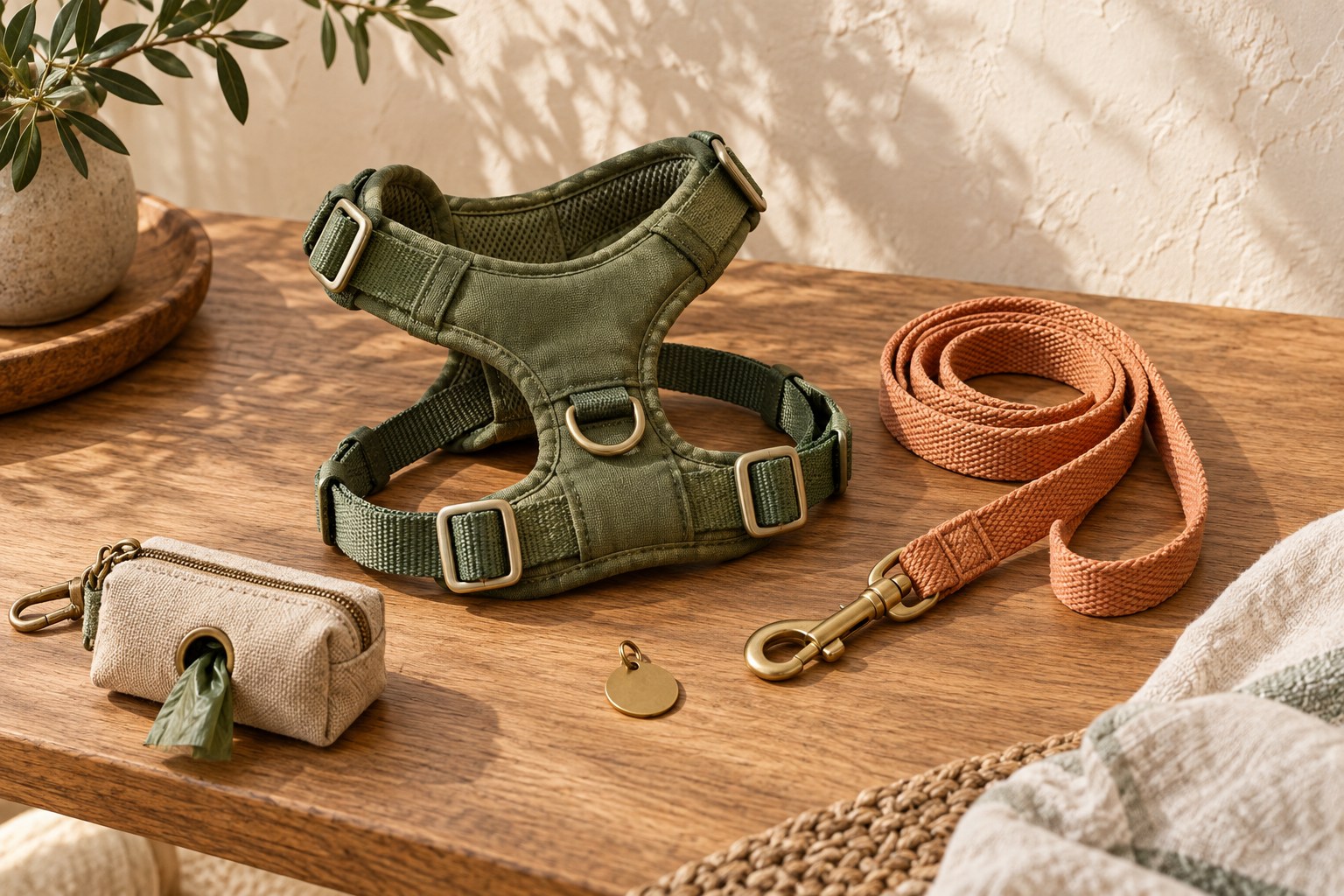
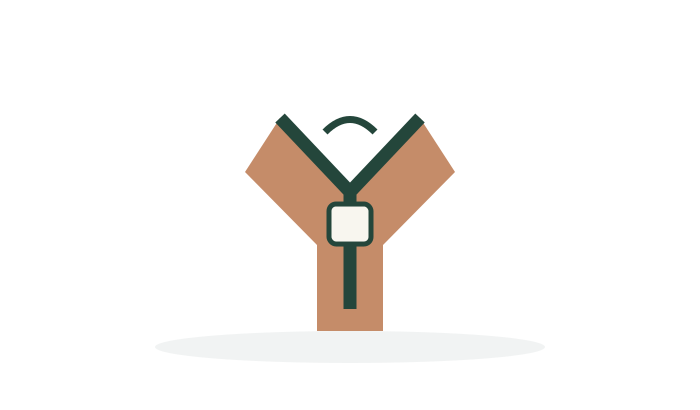
A Y-front harness divides around the neck before meeting at the chest. That shape can leave the shoulders relatively open, but the letter on the packaging does not guarantee a comfortable fit. Strap angle, chest depth, and the position of the girth band matter as much as the overall outline.
Start with the dog standing naturally. A harness fitted while the dog is curled up may look surprisingly different once the front legs extend.
Read the shape on the dog
Locate the breastbone at the front of the chest. The meeting point of the Y should rest around that firm area rather than pulling high against the throat. Follow the side straps toward the back: they should not cut across the moving front of each shoulder. A narrow dog may need a different pattern from a broad dog even when both share the same chest measurement. Photographing a side view can reveal angles that are difficult to see from above.
Put the girth band behind the action
The band around the ribs needs room behind the front legs. If it touches the soft fold immediately behind an elbow while standing, it may rub with every step. Adjust the connecting strap under the chest if the design allows it; tightening the entire harness will not create missing length. Watch several slow steps and a turn in each direction. Long fur can hide a strap drifting forward, so part the coat and check where the webbing actually lands.
Test the adjustment range
Measure according to the maker’s diagram, then compare those numbers with the smallest and largest settings. A dog near either end of a range may have little useful adjustment left. Distribute strap changes evenly so the back panel remains centered. Slide flat fingers under the straps to look for obvious pressure, but also inspect whether a leg could pass through a loose opening. Finger clearance is a starting observation, not proof that every body shape is securely fitted.
Check under gentle walking load
Attach the leash and walk indoors or in a secure enclosed space. Ask for an ordinary turn rather than a sudden tug. The harness may rotate slightly, but it should not swing a buckle into an armpit or pull the chest piece sideways. If the dog backs away, keep the leash low and loose while you reassess instead of testing escape resistance with force. Examine the skin and coat afterward for a concentrated pressure line, and repeat the fit check after laundering or growth.
Compare two plausible sizes on paper
Imagine a dog whose rib measurement falls near the middle of a small harness range but whose neck falls at its largest setting. The next size might place the neck comfortably within range while leaving the girth near its smallest setting. Neither option wins automatically. Compare the underside connector length and chest-panel width as well: the larger pattern may push the rib band farther back but also create an opening too broad for the shoulders.
Before ordering, ask for those missing dimensions and check the return conditions for a clean indoor fitting. Keep tags attached if required and use the same standing measurements for each comparison. Write down why a candidate fails: neck opening too broad, connector too short, buckle touching elbow, or panel rotating. That list is more useful than simply recording that the size was wrong, because the next model may use a completely different scale.
Separate padding from pressure distribution
A thick pad can soften an edge, but it can also add a large panel where a narrow strap would have left the shoulder free. Check the actual contact area with the harness loaded gently. The padding should not fold into a ridge or trap a buckle against the body. Mesh can still have firm binding around its perimeter, and soft foam can compress enough that underlying webbing becomes the main contact point.
For a hypothetical warm-weather outing, compare an open webbing Y-front with a padded version of the same apparent size. The webbing model may offer less coverage but require especially smooth edges; the padded model may feel broader but occupy more space behind the legs. Choose from the finished fit and intended conditions. Do not assume that more material necessarily means less pressure, or that the lightest design necessarily offers the best movement.
Keep the chosen fitting notes with the harness model details. If another person adjusts the straps or the harness is replaced with an updated version, repeat the movement check rather than copying slider positions blindly. Small construction changes can alter where an apparently familiar pattern lands.
For our approach to product claims and illustrations, see the Editorial Policy.