A tug toy is an object two participants hold at once. That makes spacing central to its design. A toy can be appropriately large for a dog's mouth yet too short to keep a person's hand comfortably away from the active gripping area. Consider the complete interaction rather than only a weight range on the package.
Choose a product intended for tugging and follow its size and use guidance. A decorative rope or improvised household strap may have unsuitable fibres, fittings, or stretch. Keep shared play controlled and stop before the toy becomes a solo chewing project.
Separate the two grip zones
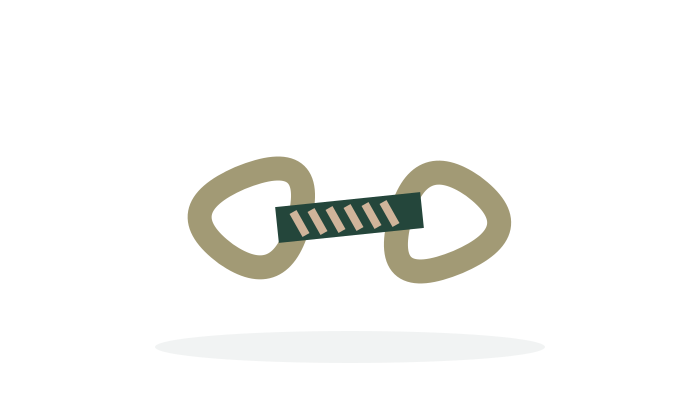
Look for a clear area for the dog and a distinct area for the hand. Long designs give more space but can trail on the floor or wrap around objects if managed carelessly. The right length should remain easy for the person to control without winding it around a wrist.
Do not use a loop as a restraint or put body parts through it in a way that prevents immediate release. A handle is a grip feature, not an anchor. Keep the play area clear so the toy cannot catch on furniture during a change of direction.
Compare thickness with flexibility
A very thin toy may be easy to fold but offer little separation between grips. A very thick toy may be awkward for a smaller animal to hold. The material's compressibility matters as much as its measured diameter, so compare side views and the maker's intended size range.
A hypothetical soft flat tug can present a broad surface while folding comfortably, whereas a rigid cylindrical shape of the same width behaves differently. Do not assume that adding thickness automatically makes the toy stronger or more suitable. Look at seams and connection points as well.
Inspect handles and joins
The connection between handle and central section carries repeated load. Examine stitching, moulded joints, knots, and any metal hardware. Select construction intended for the activity rather than relying on a material name such as nylon or rubber to establish the whole product's suitability.
Avoid exposed hard fittings near the dog's gripping area. If a sewn loop begins opening or a moulded join cracks, remove the toy. A frayed handle is not simply a cosmetic issue when it is the part the person depends on to control the interaction.
Keep movement manageable
Use the toy according to its intended play guidance and keep the animal's feet on the ground. Avoid lifting or swinging a dog by a held toy. Stronger resistance is not required to make shared play useful, and abrupt movements can make the interaction harder to manage.
If the dog repeatedly regrips near the hand, pause and reset the grip rather than continuing. A longer toy or a more clearly defined centre may help, but equipment does not replace a manageable play routine. Keep sessions short enough that both participants remain coordinated.
Distinguish tugging from chewing
A toy designed for a brief shared pull may not be intended for prolonged chewing. Remove it when the activity ends and inspect the full length. Fabric fibres, loose rope strands, and soft damaged sections deserve particular attention because a toy can weaken internally while retaining its overall shape.
If the dog prefers to lie down and dismantle the toy, choose another appropriate activity instead of leaving it available. Follow the manufacturer's supervision and replacement guidance, and retire any toy whose material is breaking away.
Fit the storage and washing routine
Tug toys often collect moisture and floor debris. Check whether they can be washed and how they should dry. Dense rope and padded handles may remain damp inside after the surface feels dry. Store the toy where it can dry and where the pet cannot retrieve it unsupervised.
For a small home, one well-sized tug that is easy to wash can be more practical than several complex shapes. The useful purchase creates clear grip spacing and remains straightforward to inspect after every shared session.
For our approach to product claims and illustrations, see the Editorial Policy.