
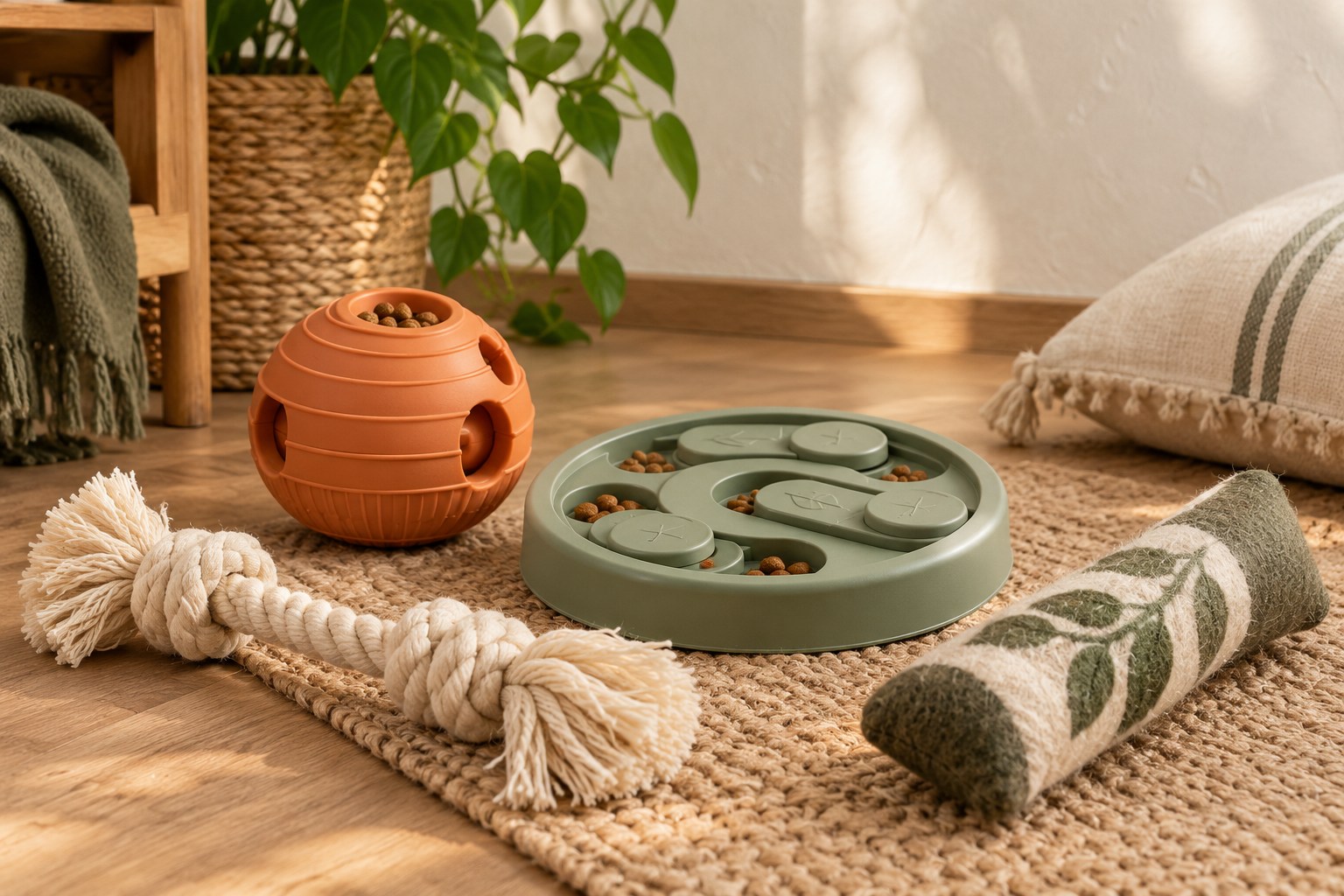
A food puzzle changes how a cat reaches part of an already appropriate serving. It does not need to replace every ordinary feeding opportunity or become as restrictive as possible. The starting goal is a clear, achievable interaction with an object the cat can investigate comfortably.
Choose a product intended for cats, use suitable food within the individual's established feeding plan, and supervise the introduction. Keep familiar access available while assessing the puzzle. A cat leaving a closed compartment untouched does not establish that it is uninterested in all puzzles; the mechanism or presentation may simply be unclear.
Begin with physical access
Look for a low stable base and wells that are broad enough to reach as intended. Tall narrow tubes, steep deep cavities, and heavily recessed openings can create very different tasks. Check the usable dimensions rather than relying on the board's overall size.
Inspect moving parts and removable components. A broad fixed slider avoids loose pieces, while a lift-out cup becomes a separate object during use. Follow the maker's size guidance and do not assume a small puzzle is automatically designed for a cat because it fits on a windowsill.
Make the first result obvious
Follow the product's introduction instructions, starting with accessible food in open areas where the design permits. Let the cat investigate without repeatedly moving its paws or forcing contact. A small visible amount gives a clear outcome and limits the number of hidden leftovers to track.
When the cat uses open wells comfortably, add one partial cover rather than closing every section. A half-open slider can reveal the relationship between movement and access. Leave another area easy so the session does not depend entirely on discovering one unfamiliar action.
Choose the action from observation
Watch whether the cat investigates with a paw, nose, or a combination. Some designs suit one approach more clearly than another. If the cat keeps trying to reach from a direction blocked by the housing, the layout may be a poor match even though the moving part works smoothly.
For a hypothetical broad-slider puzzle, a cat may collect food from the open end but ignore the covered end. Moving the panel slightly farther open may clarify the action. Switching immediately to a dense tower adds several new variables and makes that observation less useful.
Keep the location quiet and accessible
Place the board in a clear area where the cat can approach and leave without squeezing past another animal. A confined corner may make access uncomfortable regardless of the puzzle. In a multi-pet home, supervise individual opportunities rather than judging the toy by which animal empties it first.
Use a stable surface and check that the board does not slide or rock. Avoid placing it on a high edge where a nudge could send it down. Food released outside the puzzle should remain visible and easy to collect afterward.
Simplify before extending the session
Repeated ineffective action, leaving the board, or trying to overturn it are reasons to reassess. Open a compartment within the supported setup or end the activity. A longer session is not evidence of better engagement when the cat cannot reach the remaining food.
Keep notes about the actual configuration: one slider partly open, three shallow wells used, or board moved on tile. Those details help you repeat a workable setup. Labels such as beginner and advanced are less informative than the particular action the cat can perform comfortably.
Close the loop with cleaning
After use, inspect under covers, inside tracks, and beneath the board for leftovers. Remove all food, disassemble only as directed, and wash permitted parts. Dry the full food-contact path before resetting, including sheltered spaces around moving mechanisms.
A puzzle that is pleasant to use but tedious to clean may not suit frequent sessions. Choose accessible construction and keep a simple alternative available. Progress can mean a reliable familiar activity with a small variation, rather than a continuing sequence of more elaborate purchases.
For our approach to product claims and illustrations, see the Editorial Policy.