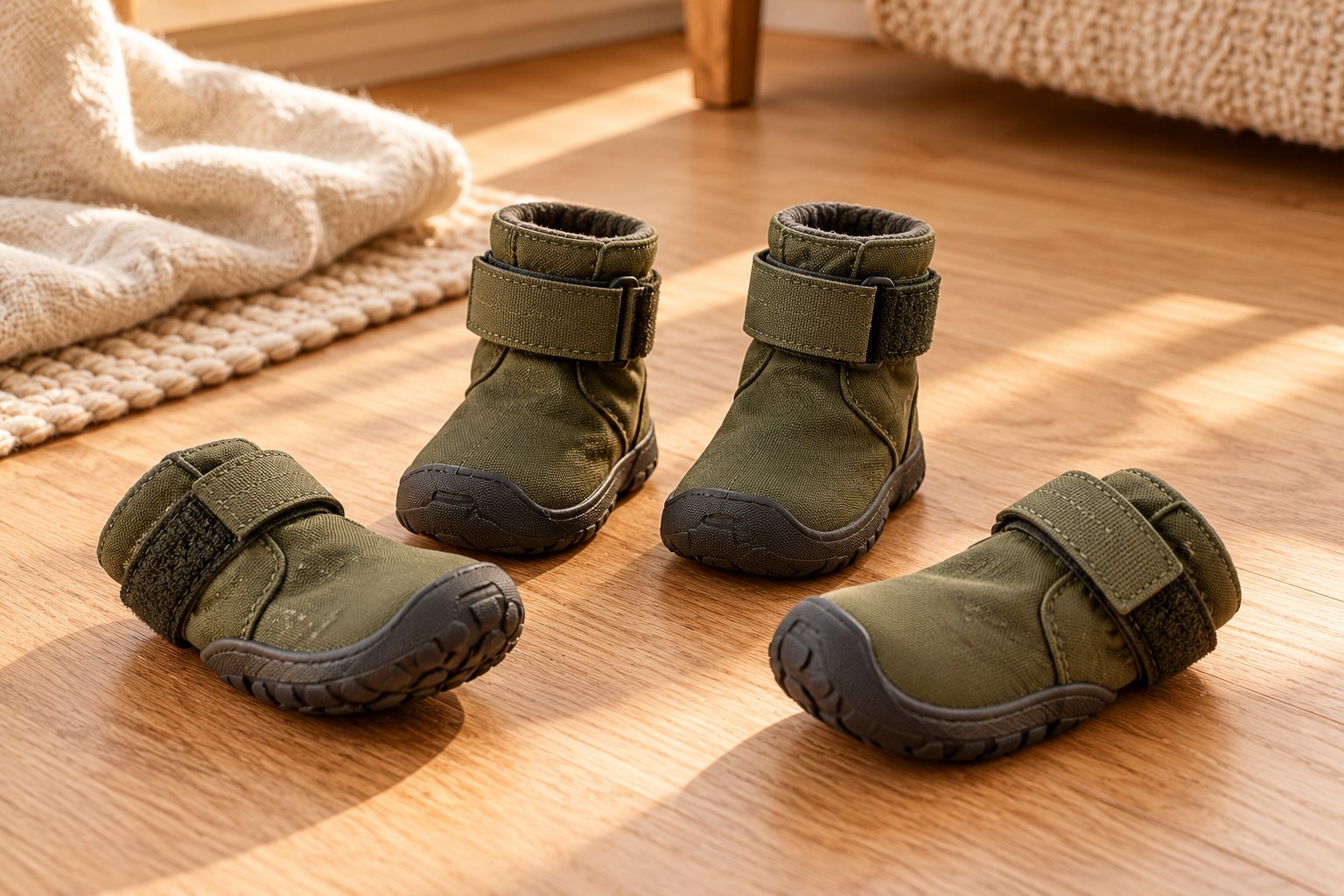
Dog boots need to match a moving, weight-bearing paw rather than a neat outline held in the air. A paw often spreads under load, and front and rear feet may differ. A boot that is too narrow can compress the toes; one that is too broad can rotate until the sole no longer sits beneath the foot.
Measure according to the maker’s method and evaluate the boot through movement, not just fastening.
Measure while the paw bears weight
Use a stable nonslip surface and follow the manufacturer’s diagram for width and length. Some request the widest standing paw width; others include nail length in a specific way. Keep the dog comfortable and avoid forcing a foot flat. Record each paw if the maker offers individual sizes or pairs. A hypothetical dog may need a larger front pair than rear pair, so buying four identical boots solely from a front-paw measurement can create loose rear boots.
Compare the sole outline
Width is not the only dimension. A long narrow paw and a short broad paw can share one measurement but fit very different sole shapes. Inspect whether the boot narrows sharply at the toe or has enough interior space for natural spread. Thick seams inside the toe box can reduce usable room. Check how the boot opens: a wide opening can simplify placement, while a narrow cuff may require tugging that folds fur and leaves the foot incompletely seated.
Place closures above the paw correctly
A strap needs to secure the boot at its intended location without clamping tightly or lying across a sensitive joint. Read the fitting instructions and check whether dewclaws fall near a seam or strap edge. Smooth the lining before fastening so it does not bunch. If the only way to prevent rotation is extreme tightening, the size or shape may be wrong. A tall cuff can offer coverage but also creates more surface area where fit and flexibility must be checked.
Watch a short indoor trial
Introduce one brief wearing session on a secure floor and observe a few ordinary steps. An exaggerated initial gait can occur because the sensation is unfamiliar, but persistent distress, slipping, or a boot turning sideways needs attention. Check that each paw is fully seated and that soles remain underneath. Do not begin with a long outdoor walk. Remove the boots and inspect the feet and contact areas, seeking veterinary advice for discomfort or an existing paw problem rather than trying to manage it by tightening equipment.
Reassess after use and washing
Material can soften, closures can collect debris, and damp lining can change friction. Inspect the boots after a few minutes outdoors, then again at the end of a short outing. Note which foot loses alignment and whether the same boot behaves differently on another foot of compatible size. Follow care instructions and dry the interior thoroughly. Keep records of the measurements and the actual sizes selected so a lost boot can be replaced with the same compatible shape.
For our approach to product claims and illustrations, see the Editorial Policy.