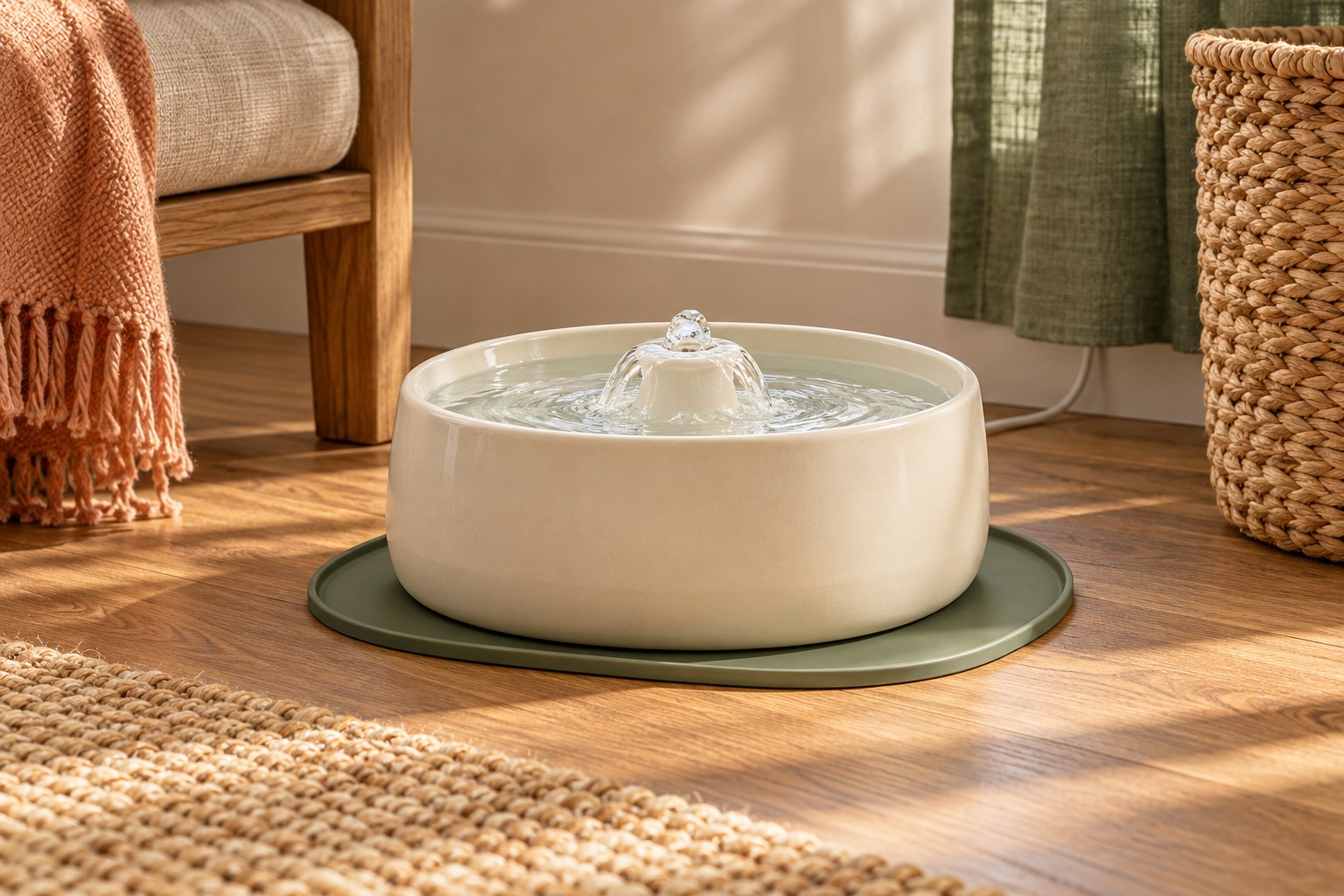
A fountain needs more than a spare patch of floor near an outlet. It needs a comfortable approach, room to remove its lid, and a safe route for the power cable. When any of those details is missing, even a well-designed fountain can become inconvenient to use.
Start with the manufacturer's electrical and placement instructions. Then consider how people and animals actually move through the room. A tidy corner in a photograph may sit directly in the path of a cupboard door or a hurried foot.
Map access at floor level
Use paper or cardboard cut to the fountain's full footprint, including any cable exit. Leave it in the proposed location while you walk through ordinary household tasks. Check whether a pet can approach and turn around without squeezing between furniture.
For a household with more than one animal, a dead-end position may create avoidable congestion. A location with more than one approach can make access easier to observe and manage. Do not assume a large reservoir solves an access problem caused by a narrow corner.
Plan the cable before filling
Measure from the fountain's cable exit to the suitable power point along the intended route. Account for the path around furniture rather than measuring a straight line through the air. Follow the manual's guidance on adapters, connectors, and water exposure.
Avoid running a loose cord across a doorway or where it invites chewing. A cable cover may help organise a route, but it must suit the cord and location and cannot make an unsuitable electrical setup appropriate. If the safe route is impractical, choose another location or a nonpowered water bowl.
Check noise where it will be heard
Water sound changes with the room's surfaces and the furniture below the fountain. A hard cabinet can transmit vibration differently from a stable floor. Test the fountain at its specified water level before deciding that a bedroom-adjacent location will be quiet enough.
Do not suppress vibration by surrounding the unit with towels or blocking required openings. Use only placement methods compatible with the instructions. If a low tray is added, confirm that it stays level and leaves all components in their intended position.
Make servicing easy
Imagine lifting the full reservoir and carrying it to the sink. A very large capacity can mean fewer refills but more weight per trip. Check that the lid comes off without moving a shelf and that the pump cable can be disconnected as instructed.
Leave enough working room to see underneath during cleaning. A leak or ordinary splash can remain hidden when a fountain is pushed against a wall. A small, accessible station that gets checked regularly is more practical than a large unit installed where it is difficult to move.
Account for the route to the sink
Measure the carrying route, including narrow doors and the distance to a suitable cleaning area. A large fountain may fit its floor position while being inconvenient to transport when full. If the reservoir can be removed, check whether its handle is intended to carry the loaded part and whether it can be set down securely at the sink.
For a hypothetical apartment with a water station beyond a dining chair, moving the chair at each refill may soon become irritating. Shifting the fountain slightly can improve service access without changing the pet's approach. Test that new footprint with ordinary household movement before settling it. A practical station supports the person who maintains it as well as the animal using it.
Check everyday light and visibility
You should be able to see the fill mark and the floor around the fountain without moving furniture. A dark alcove may hide ordinary drips or make the water level difficult to judge. Use the room's normal lighting during the placement test rather than evaluating only in bright daylight.
If a clear reservoir sits behind an opaque decorative sleeve, check how the level is read when assembled. Built-in lights or alerts may be useful but should not be the only way you verify water remains available. A visible, accessible location makes the routine simpler for everyone checking the station.
For our approach to product claims and illustrations, see the Editorial Policy.