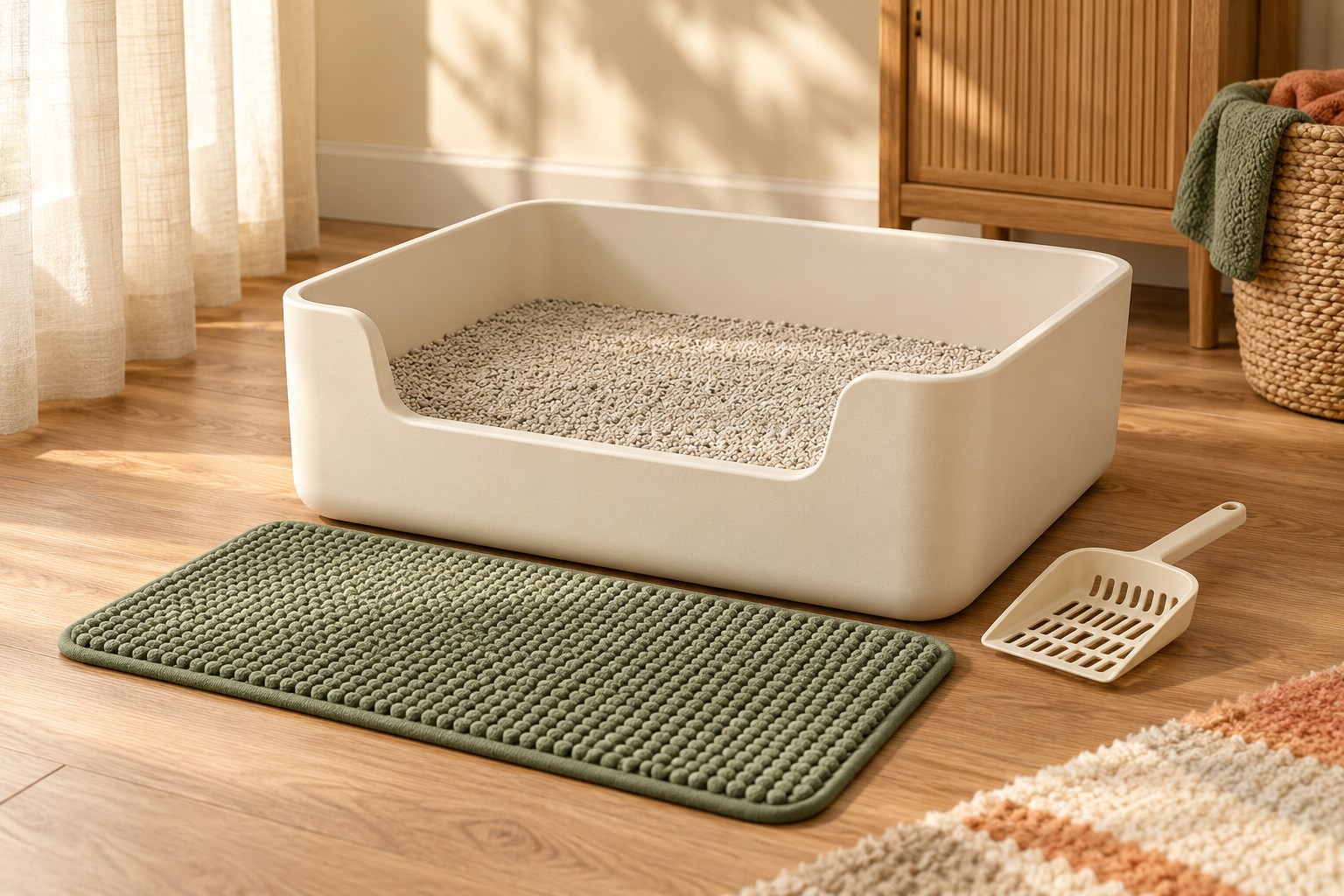
A top-entry box asks a cat to reach an upper opening, descend into the enclosure, and reverse the process to leave. That can help contain visible scatter in some homes, but it creates a more demanding route than a low open tray. A tidy exterior does not show whether the interior or access suits the cat.
Consider this style only after assessing movement, usable room, and the daily maintenance process.
Break the entry into separate movements
The cat may need to jump to the lid, turn toward the opening, lower itself inside, and later climb back out. Each stage needs room and secure footing. A hypothetical cat comfortable jumping onto a broad table may still find a small smooth lid awkward because it offers less landing area. For a cat with mobility limitations or a recent change in movement, consult a veterinarian and prioritize an accessible alternative rather than trying to encourage a difficult route.
Read the interior dimensions
The hole size does not describe the whole interior. Check the floor area, internal height, and whether corners taper or contain projections. A cat needs room to turn and position itself after entering. If the top opening sits at one end, consider how the cat moves beneath the remaining lid. Ask for measurements where the listing is unclear. Avoid assuming a tall enclosure offers generous room simply because the exterior occupies substantial vertical space.
Inspect the lid as a platform
The lid needs to remain secure according to its design and provide appropriate traction without sharp edges or loose coverings. Perforated or textured surfaces may capture some litter, but openings and seams also need inspection. Check how the lid locks and whether a handle is intended only for removing it. Do not use an unsecured lid as a step. Keep surrounding furniture stable so the cat is not relying on a lightweight stool that can move during entry.
Practice the maintenance routine empty
Remove the lid, reach every corner with the scoop, and refit it without trapping fingers or loose litter in clips. A deep box can require more bending and make waste harder to see. If the lid must be placed on the floor during scooping, plan a clean convenient place for it. Evaluate whether the enclosure separates into manageable pieces for the manufacturer’s recommended maintenance. A product that is awkward to service can undermine the very routine it was intended to simplify.
Introduce without removing the easy option
When practical, keep a familiar accessible box available while offering the new design. Do not drop the cat through the opening or repeatedly lift it onto the lid. Observe voluntary exploration and normal use. If the product permits removing the lid during introduction, follow its instructions and do not assume that lid-free use predicts comfort once the lid returns. Maintain other variables where possible so you can identify whether the entry route is the feature affecting choice.
Reconsider the purpose if use is hesitant
A top entry should not be purchased simply to exclude another pet or conceal a maintenance problem. Access management may need a room layout or appropriately selected barrier instead. If the cat avoids the enclosure, return to a suitable easy-access option and investigate. New toileting changes can have health causes and warrant veterinary guidance. The amount of litter outside the box is only one measure; comfortable voluntary access and a workable maintenance routine matter more.
Separate scatter control from access control
A top-entry box is sometimes considered because another pet investigates an ordinary tray. That decision combines two questions: whether the cat can use the new route comfortably and whether the other animal is actually excluded. A dog may still reach through the top, while a cat with reduced mobility may find the entry harder than expected. The appearance of separation is not proof that both needs have been met.
A supervised trial should observe the whole sequence without allowing harassment around the opening. If reliable separation is needed, a suitable room-access arrangement may be more appropriate, provided the cat retains a comfortable unobstructed route. Keep essential resources available while evaluating options.
Similarly, less litter visible on the floor does not show that the cat prefers the enclosure. Check normal use, turning space, and ease of departure independently. The strongest reason to keep a top-entry design is that the cat uses it comfortably and its maintenance works for the household, not that it solves a human concern while concealing a new difficulty inside.
Recheck access as the cat ages or its mobility changes. A route that was previously comfortable may become unnecessarily demanding, and retaining a low-entry alternative allows the household to respond without an abrupt loss of suitable toileting space.
For our approach to product claims and illustrations, see the Editorial Policy.