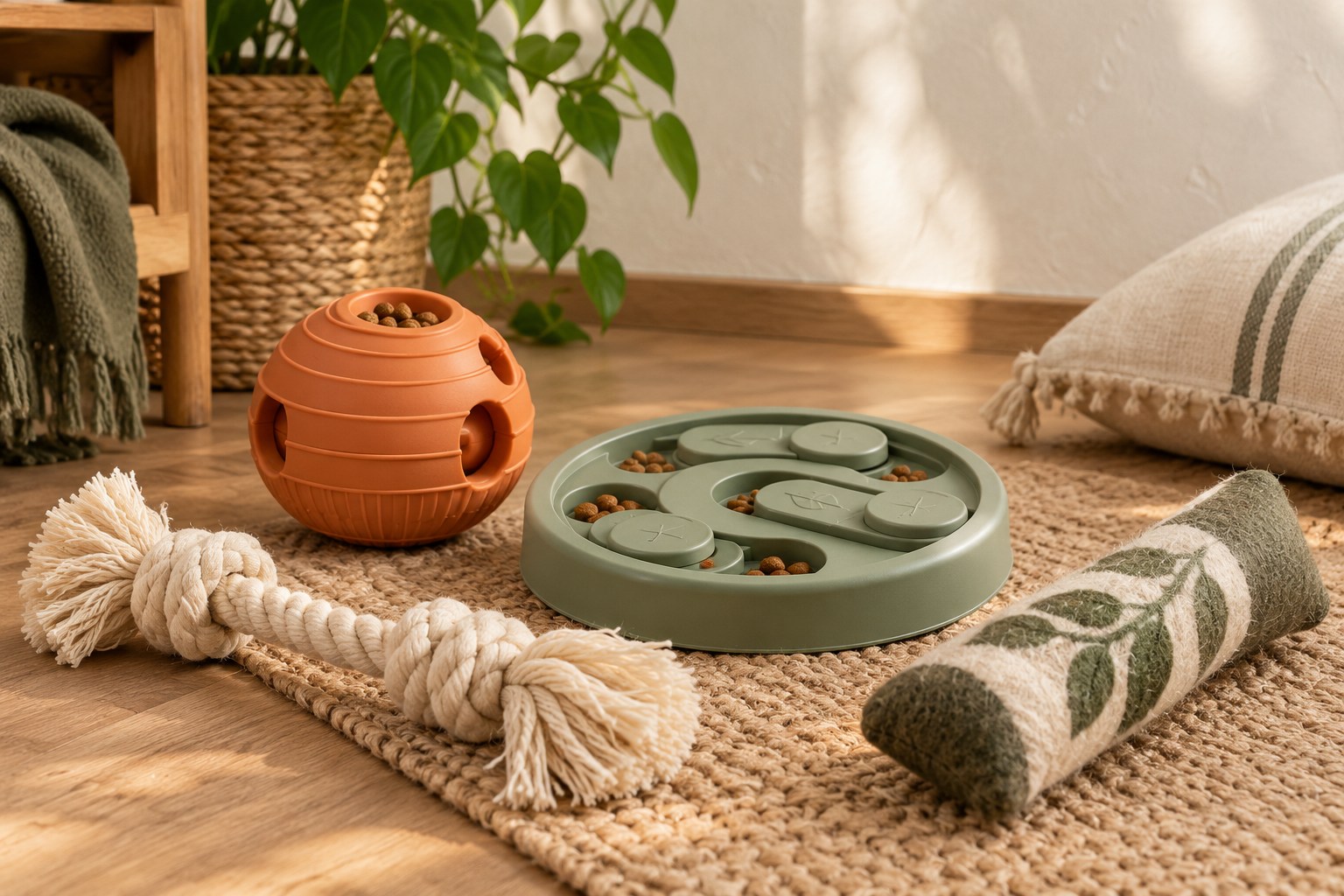
Two puzzles with the same difficulty label may ask for completely different actions. One requires a nose to slide a panel. Another needs a hinged lid lifted. A third uses loose pieces that must be removed. Understanding those actions helps you choose a design that fits the animal's current interaction and your ability to supervise it.
Do not select only by how many compartments a board contains. A simple movement repeated across several wells can be useful, while a single awkward hinge can make a small puzzle difficult. Mechanism quality and access matter more than decorative complexity.
Understand sliding clearance
A slider moves along a constrained path. Look for a broad contact area and enough clearance that the part moves as intended when clean. Narrow grooves can trap crumbs, while excessive gaps may admit material into spaces you cannot reach.
Check whether panels can be removed for cleaning and how they are secured afterward. A removable slider is convenient only if it locks back into the supported position. Do not loosen screws or widen tracks to reduce resistance unless the manufacturer explicitly describes that adjustment.
Examine what a flap requires
A hinged flap may need an upward movement from a nose or paw. The lifting edge should be identifiable and reachable. A completely flush lid can be much harder to manipulate than a similar lid with a broad lip, even when the reward well is the same size.
Observe the direction the lid opens and whether it falls back over the well. Some designs require the animal to hold the opening while collecting food; others stay open. That difference changes the challenge substantially and may matter more than the number of compartments.
Treat loose pieces as a separate decision
Lift-out pegs and cups can provide an obvious movement, but they become separate objects once removed. Check the maker's size guidance and supervise closely. A pet that carries pieces away or chews them may need a design with fixed moving parts instead.
Count every removable item before and after a session. Keep unused pieces out of reach. If one cannot be accounted for, stop the activity and locate it rather than assuming it has rolled safely under furniture. Replace missing parts only with the intended compatible components.
Compare the reset process
Some puzzles take seconds to refill; others need careful rotation of several layers. Consider your hands, counter space, and cleaning routine. A complex reset can be acceptable for occasional guided play but inconvenient for a frequently used activity.
For a hypothetical pet already comfortable with broad sliders, a board with a few sliders in new positions may be a clearer next purchase than one that introduces tiny lift-out pegs. If the goal is a new movement, choose a design where that movement can be practised independently.
Test without adding resistance
Before offering the puzzle, move each mechanism yourself according to the instructions. Check for binding, sharp damage, or trapped packaging. A part that barely moves when empty is not necessarily an advanced challenge; it may be incorrectly assembled or damaged.
Use only suitable food that fits the intended wells and the pet's established feeding plan. Overfilling can block a slider or wedge a flap open. Start with a small amount so the mechanism, rather than a packed compartment, determines the interaction.
Buy for inspection as well as play
Look under hinges, inside tracks, and beneath rotating layers in the disassembly drawings. If the food-contact spaces cannot be reached, cleaning may outweigh the toy's interest. Check which components tolerate washing and how long they need to dry before reassembly.
A well-chosen mechanism gives the animal a clear action and gives you a clear maintenance route. There is no need to collect every mechanism type. A few designs that remain usable, inspectable, and interesting can serve better than a cupboard of progressively complicated boards.
For our approach to product claims and illustrations, see the Editorial Policy.