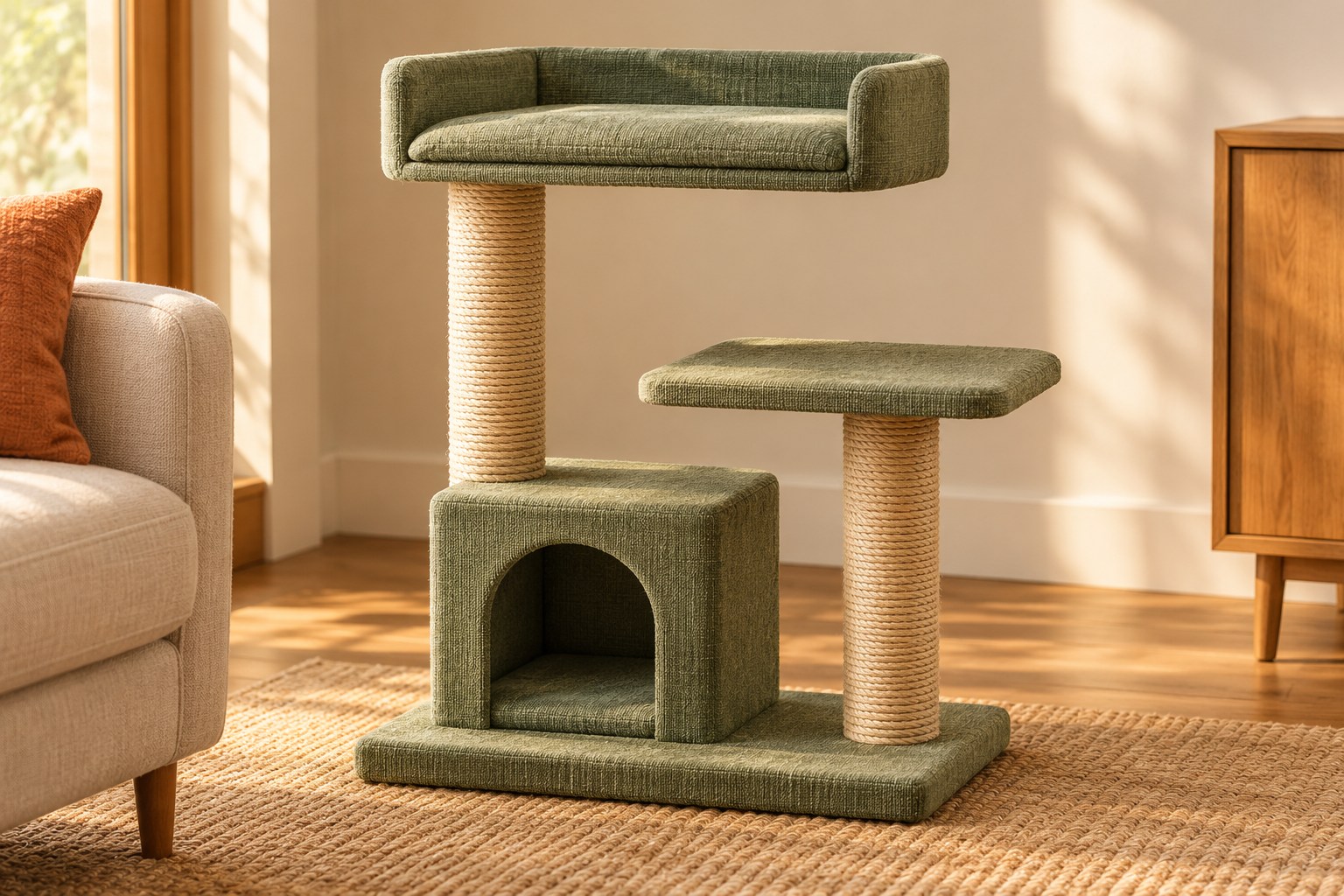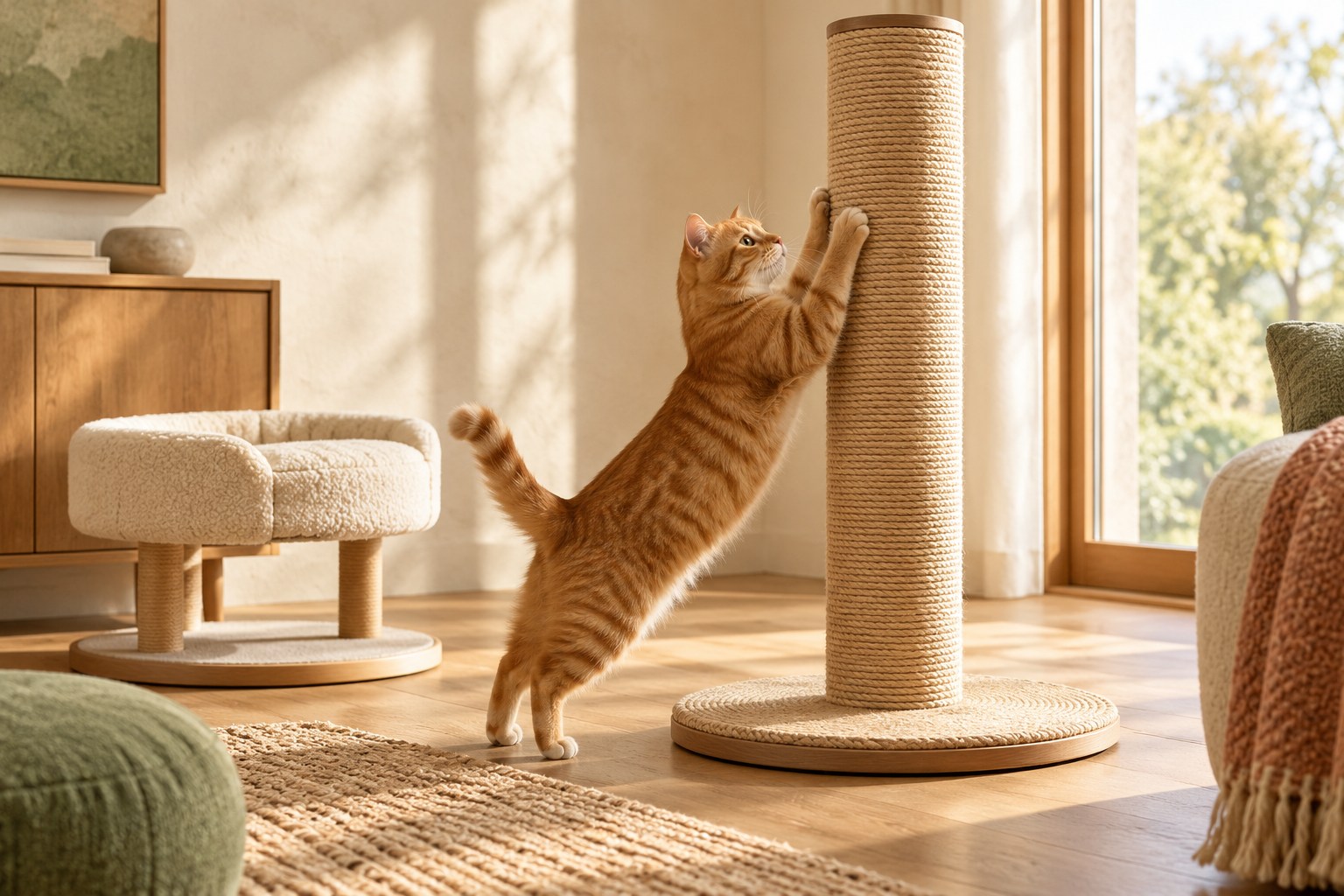
A well-made scratcher can remain unused if it sits outside the cat’s daily routes. Scratching is not an activity that always happens in a designated corner on a person’s schedule. Cats may choose prominent locations, places near resting areas, or surfaces along a familiar path.
Placement works best when it begins with observation. Keep the product stable and accessible, then use the room’s actual traffic patterns to decide where it belongs.
Map the existing pattern
For several days, note where scratching occurs and what happens just beforehand. The cat may stretch after waking, pause near a doorway, or use a sofa edge during active periods. Record the direction as well: vertical, horizontal, or angled. A hypothetical sofa-corner scratcher will be more convincing when it offers a similar orientation nearby than when it is a small flat pad across the room. Do not assume all scratching at furniture reflects a preference for that upholstery alone.
Keep the approach open
A post squeezed between a cabinet and a wall may have enough visible surface but no room for the body to extend. Horizontal pads need space for the rear feet to brace. Check door swings, chair movement, and objects stored around the base. Avoid locations where a machine starts unexpectedly or a person repeatedly steps over the cat. The useful area includes the approach and exit, not just the footprint printed on the packaging.
Offer more than one relevant location
In a multi-room home, one scratcher may be too far from the moments when scratching happens. In a multi-cat home, a single narrow approach can also be controlled by another cat. Distribute suitable surfaces instead of clustering every option together. This does not require buying a large tower for every room; a stable flat pad and a sturdy post can serve different locations. Watch whether each is accessible without passing through another cat’s preferred resting space.
Protect furniture while alternatives become familiar
Use furniture protection compatible with the surface and the cat’s environment, following the product’s instructions. Position a suitable scratcher near the established target and reward voluntary use. Avoid punishment or physically moving the paws onto the new surface. A protector that blocks one corner without offering a workable nearby alternative may simply redirect scratching to the next exposed edge. The plan should provide an outlet, not only remove access to existing choices.
Move products gradually and deliberately
If a scratcher becomes regularly used but its position is inconvenient, shift it a small distance at a time while observing whether use continues. There is no need to force a move if the new position loses the feature that made the location meaningful. Avoid repeatedly rearranging all scratching resources during a room refresh. Keep at least one familiar accessible option available, and check that new furniture does not block an existing approach.
Review location before replacing material
When a product is ignored, test a sensible location change while keeping the same surface and orientation. If that does not help, compare usable dimensions and stability next. Changing everything at once makes it difficult to learn what mattered. A short observation note can reveal that the cat uses a post only when a chair is pulled out, pointing to access rather than texture. Replace an unsuitable product when needed, but let behavior guide the reason for the purchase.

For our approach to product claims and illustrations, see the Editorial Policy.