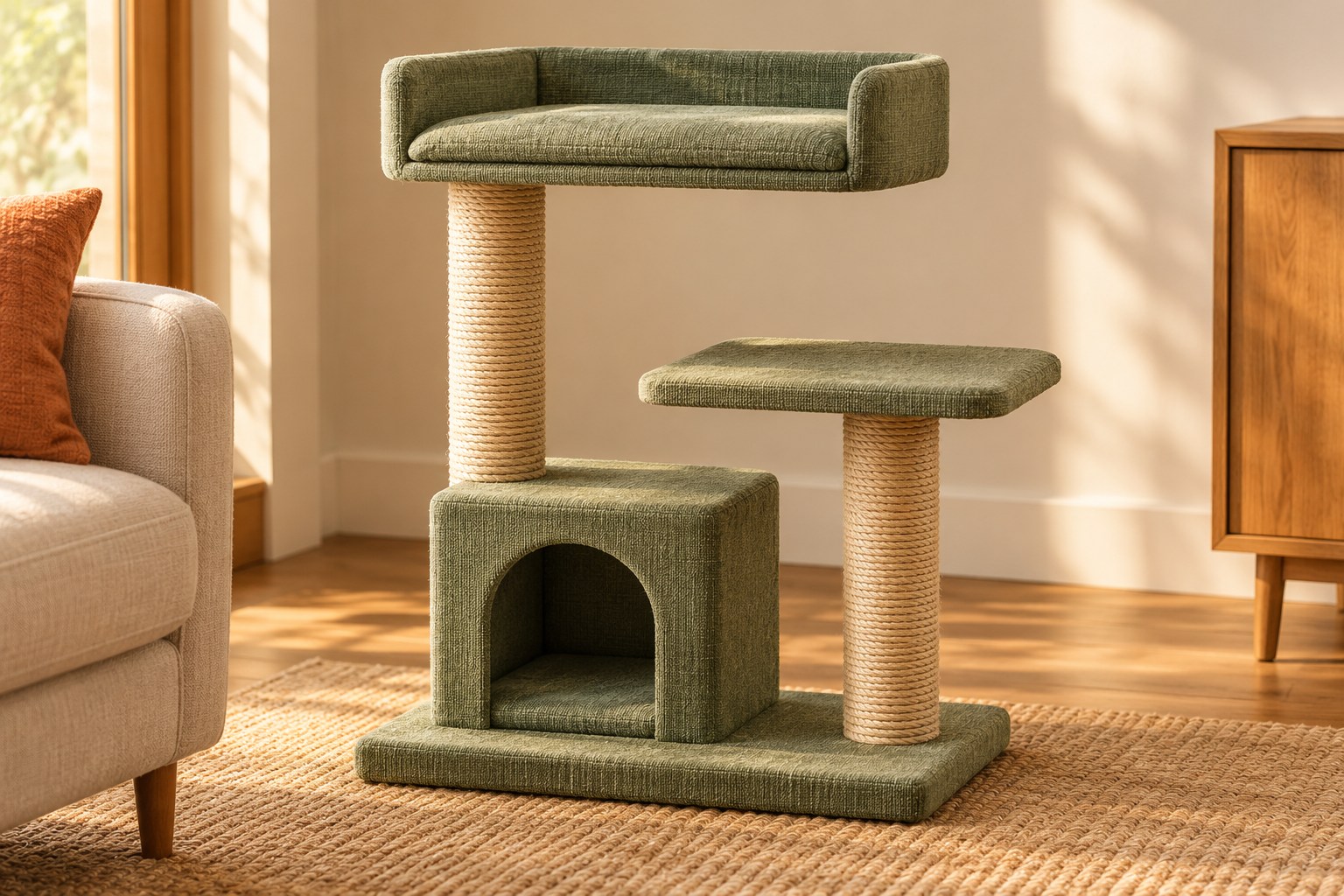
A tree with many platforms is not necessarily a good shared resource. If every route passes through one narrow shelf, one cat can control access to everything above it. If the top perch has only one way out, another cat approaching from below may make it feel less comfortable. Shared climbing furniture needs a route plan as well as enough surface area.
Watch how your cats use space independently before choosing a tower advertised for several cats.
Distinguish capacity from coexistence
A structural weight limit addresses a product condition, not the cats’ willingness to occupy it together. Two cats may comfortably use separate levels while avoiding a shared enclosed cubby. Others may prefer entirely separate towers. A hypothetical household with one confident climber and one cautious cat may gain more from two modest structures in different areas than from a single tall tree. Base the layout on observed access and comfort rather than a photograph of several cats posed together.
Draw the routes up and down
Imagine a line from the floor to each platform. Identify where two cats would have to pass closely and where one cat could block the only step. Look for offset platforms, more than one approach, or a neighboring stable surface that creates a supported alternative route. Avoid improvising a risky jump between unrelated furniture. Each route needs appropriate spacing, secure footing, and a clear landing area, with the manufacturer’s intended use and limits respected.
Compare platform size and orientation
A shared tree may offer several tiny shelves that function only as steps, not usable resting or observation areas. Check actual dimensions excluding posts and raised rims. Platforms facing different directions can let cats look into the room without sitting directly face-to-face. Open sight lines may help a cautious cat notice an approaching companion. Enclosed sections can provide concealment but should not become a dead end on the only route to an upper platform.
Keep important resources distributed
A tree should be one part of the home’s spatial resources, not the only elevated option. Provide appropriate scratching, resting, water, and toileting locations without forcing every cat through a single route; feeding and litter arrangements each need their own planning. Avoid placing the only tree at the end of a narrow hallway where another cat can wait at its base. Distributing usable height can reduce the need to compete for one prominent location.
Inspect stability for combined movement
Two cats moving at once create a different pattern from one cat sitting quietly. Follow the documented total and component limits and install any required restraint. Look at the base, post spacing, and projecting shelves. If one cat’s landing makes another platform sway, pause access and reassess. Do not add improvised shelves or extra hanging accessories to create capacity without manufacturer support, since those changes affect leverage and may introduce entanglement or tipping risks.
Introduce without staging interaction
Allow each cat to explore voluntarily and keep familiar alternatives available. Do not place cats together on a top platform to demonstrate that the tree can hold them. Observe approaches, pauses, retreats, and whether one cat stops using a previously favored route. Quiet displacement can be more informative than an obvious confrontation. If tension persists, qualified feline behavior guidance can help assess the wider environment; buying a larger tower alone may not address the pattern.
Review the layout after room changes
A new sofa, moved bookcase, or relocated tree can remove an exit or create a new ambush point. Reassess routes after rearranging furniture and as cats age or change mobility. Keep platforms free of stored objects and maintain grippy surfaces. A shared structure remains useful when each cat can choose to enter and leave comfortably. The measure of success is voluntary use with workable access, not whether every platform is occupied at once.
Work through a two-cat passing problem
Suppose a tree has a large top platform but only one small middle shelf. One cat rests on the middle shelf, and the other can no longer reach the top without passing closely. The total platform area may be ample, yet access is still constrained. A second independent route or a separate elevated location can be more useful than enlarging the top shelf.
Observe what happens before changing furniture: does the waiting cat retreat, stay on the floor, or approach repeatedly? Keep both cats’ choices available and avoid arranging encounters to test the theory. A quiet preference for a different route can be enough evidence that distributed access deserves consideration.
For our approach to product claims and illustrations, see the Editorial Policy.