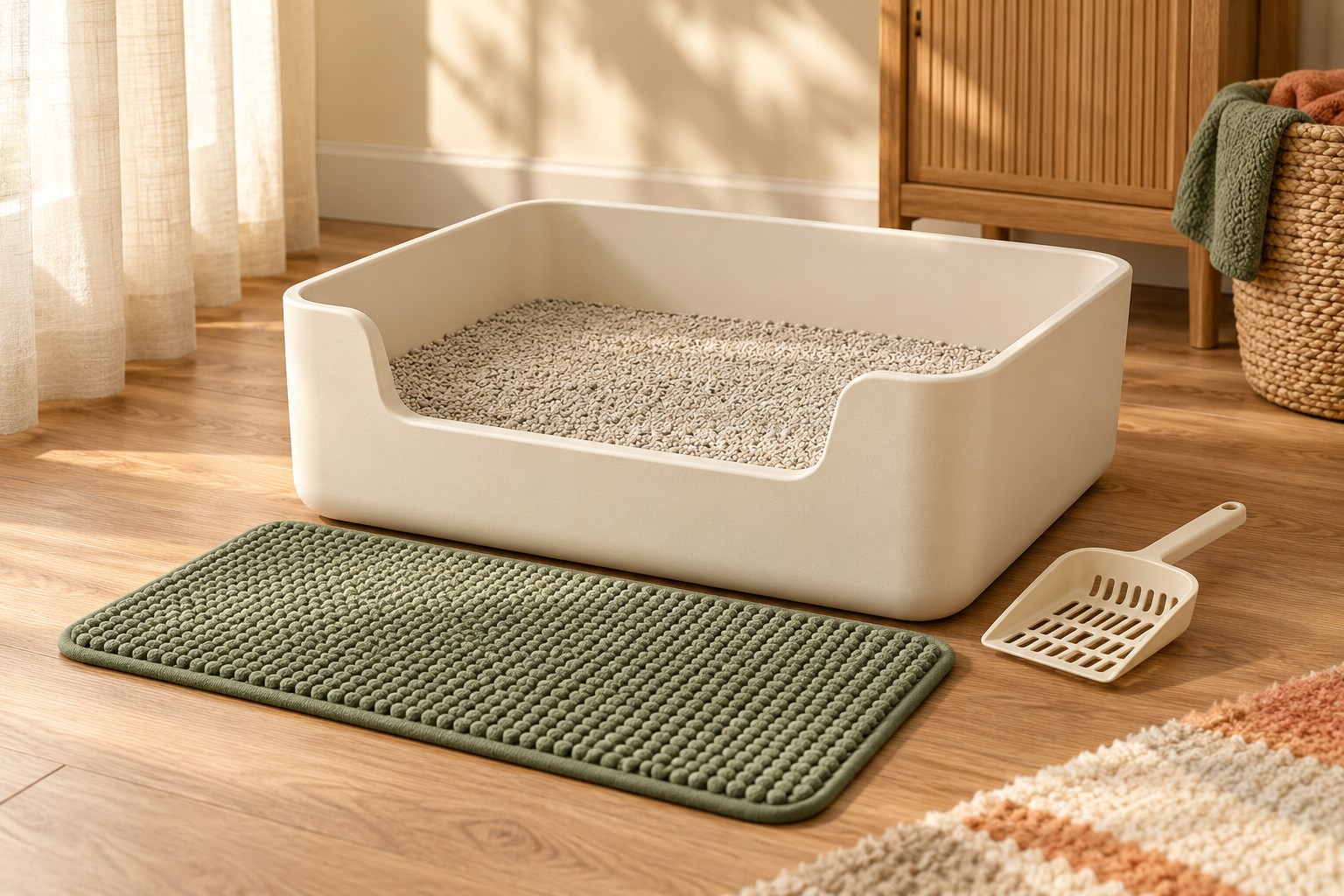
A litter scoop is a small tool used repeatedly, so its geometry affects the whole maintenance routine. Slots that suit one litter can waste another. A deep basket may carry a large amount but become heavy when lifted, while a short handle can force awkward reaching into a deep box.
Choose the scoop with the litter and box together in mind, then test the motion before committing to a large or elaborate design.
Match slots to the actual material
The openings need to let usable litter fall through while retaining the material you intend to remove. Fine clumping granules and larger pellets call for different spacing. A hypothetical scoop with very wide slots may work poorly with small fragments, while narrow slots can retain too much clean coarse litter. Check whether the product is intended for your litter type and avoid assuming one scoop design performs equally across every material.
Inspect the leading edge
A straight firm edge can reach a flat base, while rounded corners may follow curved box walls more easily. A sharp metal edge can damage some surfaces, and a very flexible plastic edge may bend before lifting compacted material. Follow the box and scoop guidance. Do not scrape forcefully at a joint or coating that the tool was not designed to contact. If maintenance routinely requires excessive force, review litter depth, schedule, and compatibility rather than buying the most aggressive edge available.
Compare basket depth and drainage
A large basket reduces the number of passes but can carry more weight and obscure what is retained. A shallow basket may be easier to inspect and empty. Hold the scoop at a natural angle and imagine shaking it gently; exaggerated repeated shaking can break retained material or scatter dust. Let the slots do the separating work. The best shape allows controlled movement with the box in its actual location, including under a shelf or inside a removable cover.
Pay attention to handle alignment
A comfortable grip keeps the wrist reasonably neutral during the repeated lift-and-tip motion. Thick handles may suit some hands while tiring others. Check whether a finger can slip into a gap between the handle and basket during use. A long handle can improve reach but also increase leverage and reduce precision. If grip strength or wrist discomfort is an issue, compare tools in person where possible and seek suitable professional advice rather than assuming a padded handle solves every difficulty.
Plan a contained storage point
The scoop should have a dedicated holder or location away from food preparation and clean supplies. A holder needs enough room that the scoop does not rest awkwardly on its leading edge. Check whether the holder can be maintained and dried according to its material. A closed container may conceal the tool but retain moisture. Keep the tool accessible enough that finding it does not become a barrier to the routine, while preventing children and pets from accessing soiled equipment.
Replace on function, not appearance alone
Inspect plastic for cracks and metal for deformation, damaged coatings, or sharp edges. A bent basket can change slot spacing and contact with the box. Maintain the tool according to instructions and replace it when structural damage makes use uncertain. Review whether the chosen scoop still suits the litter after a material change. A dependable simple tool matched to the actual granules often performs more consistently than an expensive design chosen without considering compatibility.
For our approach to product claims and illustrations, see the Editorial Policy.