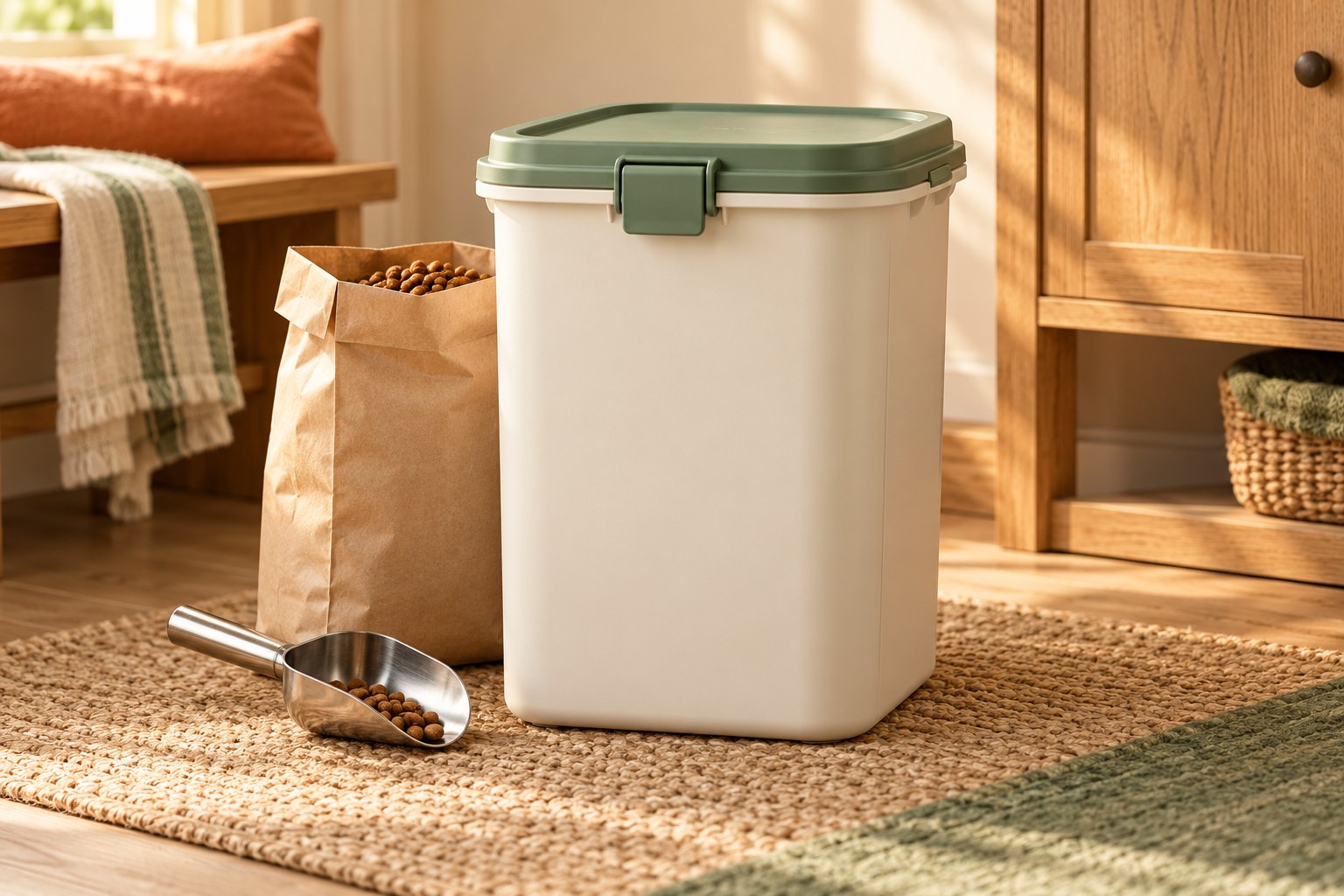
Pet food containers are often sold by a maximum bag weight, but weight does not describe a bag's shape. A tall narrow package and a short broad one can hold similar amounts while needing different containers. Plan around the actual package and the space where you will keep it.
Using the original bag inside a suitable container also keeps its product details together. If a design makes that impossible, think carefully about how you will retain the label information and follow the food maker's storage instructions.
Measure a partly used bag as well
A fresh bag may stand neatly, while a folded partly used bag becomes wider at the top. Measure both arrangements if possible. Leave room for closing the bag and placing the lid without crushing the fold into a seal or hinge.
Check the internal dimensions rather than the bin's external measurements. Thick walls, wheels, and a recessed lid can reduce usable space. A capacity label is a screening tool, not proof that the package will fit with a convenient opening left for access.
Check the cupboard motion
Measure the shelf depth and height, then account for how the lid opens. A hinged top may need clearance behind the bin. A lift-off lid needs somewhere clean to rest while you measure a serving. Both can be awkward beneath a low shelf.
Use a cardboard outline to test the footprint before buying. Pull the proposed bin forward as you would each day and open nearby doors. In a narrow cupboard, two smaller containers may be easier to manage than one large tub that cannot be removed without tilting.
Evaluate handles and wheels realistically
Handles should provide a comfortable grip when the container holds its normal load. Check whether they are moulded into the body or attached separately. A thin decorative lip is not necessarily a carrying handle, even when it seems convenient to grab.
Wheels help on a level route but add height and do little for a container that must be lifted over a threshold. Consider whether the wheels are accessible for cleaning and whether they allow unintended movement. A simple stationary bin may be preferable on a shelf.
Choose accessible seals and corners
A closure should be straightforward to open, close, and inspect. Removable gaskets can make cleaning easier if the instructions permit removal. Narrow corners and hollow lid channels need a drying plan, particularly before storing another bag.
Keep label details such as product identification and lot information available with the package. Avoid creating an endless mixed supply by adding new food over old remnants. Choose a container size that supports orderly bag changes and the storage instructions, rather than buying the largest bin that fits the room.
Consider the final third of the bag
A container that is easy to use when full can become inconvenient once the bag collapses. Check whether you can hold the opening upright and reach the remaining food without pressing against the lid or climbing over a tall rim. A removable internal support is useful only if it is intended for the container and can be cleaned.
In a hypothetical deep bin under a counter, a short-handled scoop may not reach the bottom comfortably. Choosing a shallower container or lifting the original bag out can be simpler than buying an extremely long scoop. Plan that motion before purchase and keep the load within comfortable handling limits. The useful capacity is the amount you can store and access orderly through the whole bag cycle.

For our approach to product claims and illustrations, see the Editorial Policy.