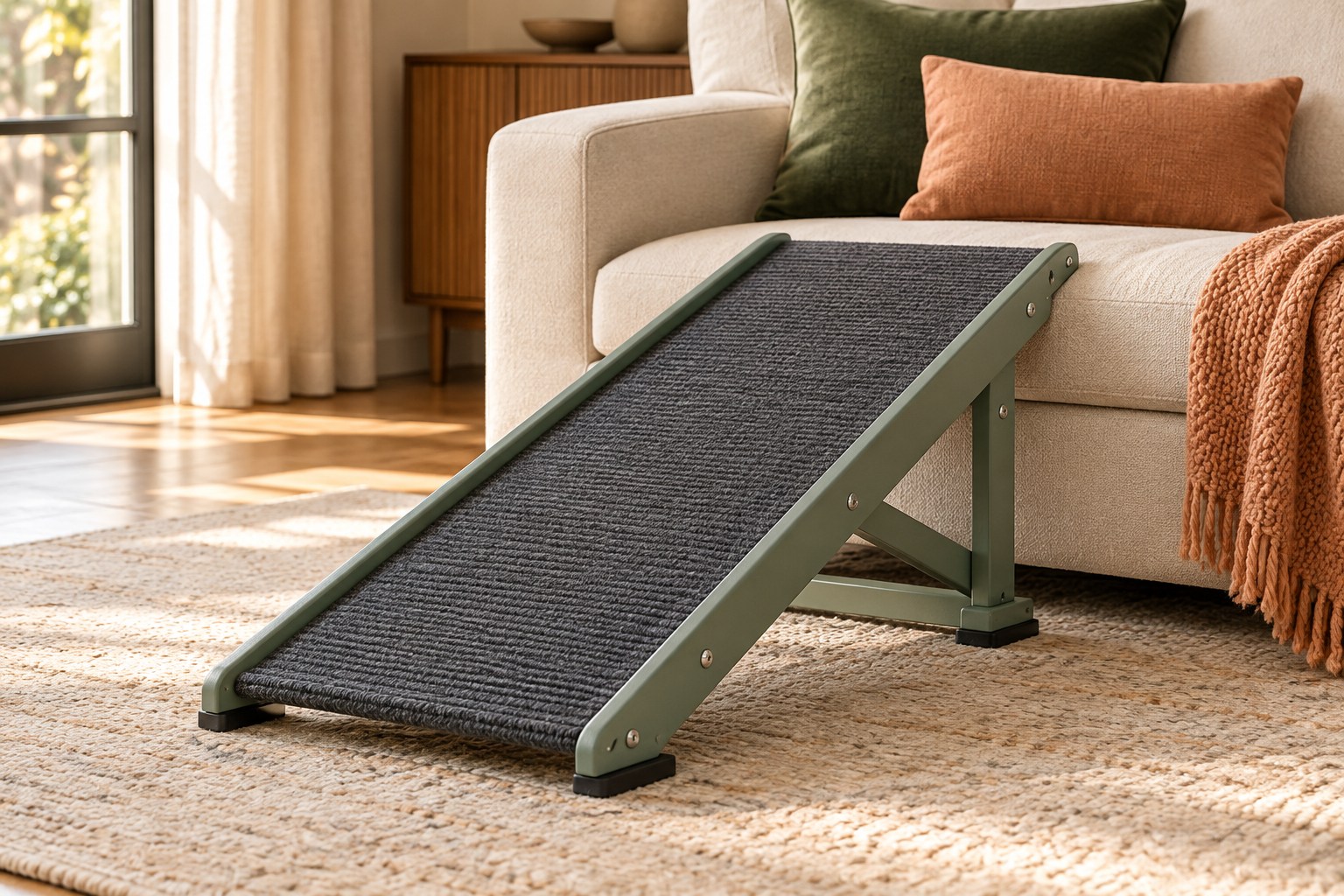
Two ramps with similar extended lengths can create very different daily routines. A folding design swings sections around hinges; a telescoping design slides sections over one another. Neither mechanism is inherently best for every household. The decision should include setup, locking, carrying, cleaning, and storage as well as the final walking surface.
Compare packed dimensions in three directions
Folding a ramp reduces its length but often increases its thickness. A telescoping ramp may form a flatter package but remain longer when closed. Measure the intended storage area, including access through the vehicle opening, rather than comparing only a single packed-length number. Handles and locking tabs may protrude beyond the main body and need their own clearance.
Think about what else must travel beside it. A ramp wedged under heavy luggage can be difficult to retrieve at the moment it is needed. Store it so it can be removed while the pet remains securely contained elsewhere. Follow the vehicle and product guidance for retaining the ramp during travel; a loose heavy accessory is a separate issue from the animal's restraint system.
Inspect the mechanism's working points
On a folding ramp, check hinge condition, required latches, and whether sections settle into the intended alignment. On a telescoping ramp, check the extension sequence, overlap, and locking method. A ramp can look fully deployed while one section remains unsecured. Use the supplied visual or tactile checks and never rely on approximate appearance when the instructions require a positive lock.
Moving joints create pinch areas. Keep the pet away during deployment and position hands as instructed. Do not ask the animal to stand on a ramp while changing its length or angle. If a latch does not engage smoothly, stop and inspect the cause rather than forcing it or bypassing it. A storage strap is not necessarily a working-position lock and should not be treated as one.
Assess the walking surface after assembly
Look along the entire path for gaps, abrupt lips, worn traction, and exposed hardware. A folding hinge may create a transition across the middle, while a telescoping overlap can form a small step. The significance depends on the exact design and the individual animal. Ask for close-up photographs if the listing shows only a distant side view.
Compare usable width between rails as well as the overall frame width. Read the load limit and intended application. Do not assume that a ramp with a high capacity can be supported at any point or used at every angle. The upper contact and lower feet still need compatible stable surfaces, and the complete product must be used according to its instructions.
Consider the handler's movement
Weight distribution changes as sections move. A long telescoping panel can be awkward to extend in a narrow space, while a folding section may need a wide swing arc. Rehearse the sequence with the empty ramp and the vehicle parked appropriately. Check whether the handler can keep a stable stance without leaning across the animal or lifting above a comfortable height.
Handles help only when they are located usefully for that sequence. A centered carry handle may work for transport but not for precise placement of the upper lip. Avoid adding improvised loops to structural parts. If the correct setup consistently feels too difficult, a different format or another suitable access plan may be preferable to a lighter but poorly controlled deployment.
Plan maintenance and storage
Folding hinges and telescoping tracks can hold dirt. Clean according to the maker's instructions and dry the ramp before closing it for storage. Do not apply lubricants or household products unless approved, especially where residue could reach the walking surface. Inspect traction panels and feet as well as the main frame. A sound mechanism cannot compensate for a slippery or damaged surface.
Keep model and replacement-part information available. If a hinge, latch, or sliding section is damaged, use the manufacturer's repair path or replace the product. Improvised screws and straps can change the mechanism's behavior. Recheck the whole routine when changing vehicles because a different loading height or storage shape may make a previously convenient ramp awkward to use.

For our approach to product claims and illustrations, see the Editorial Policy.