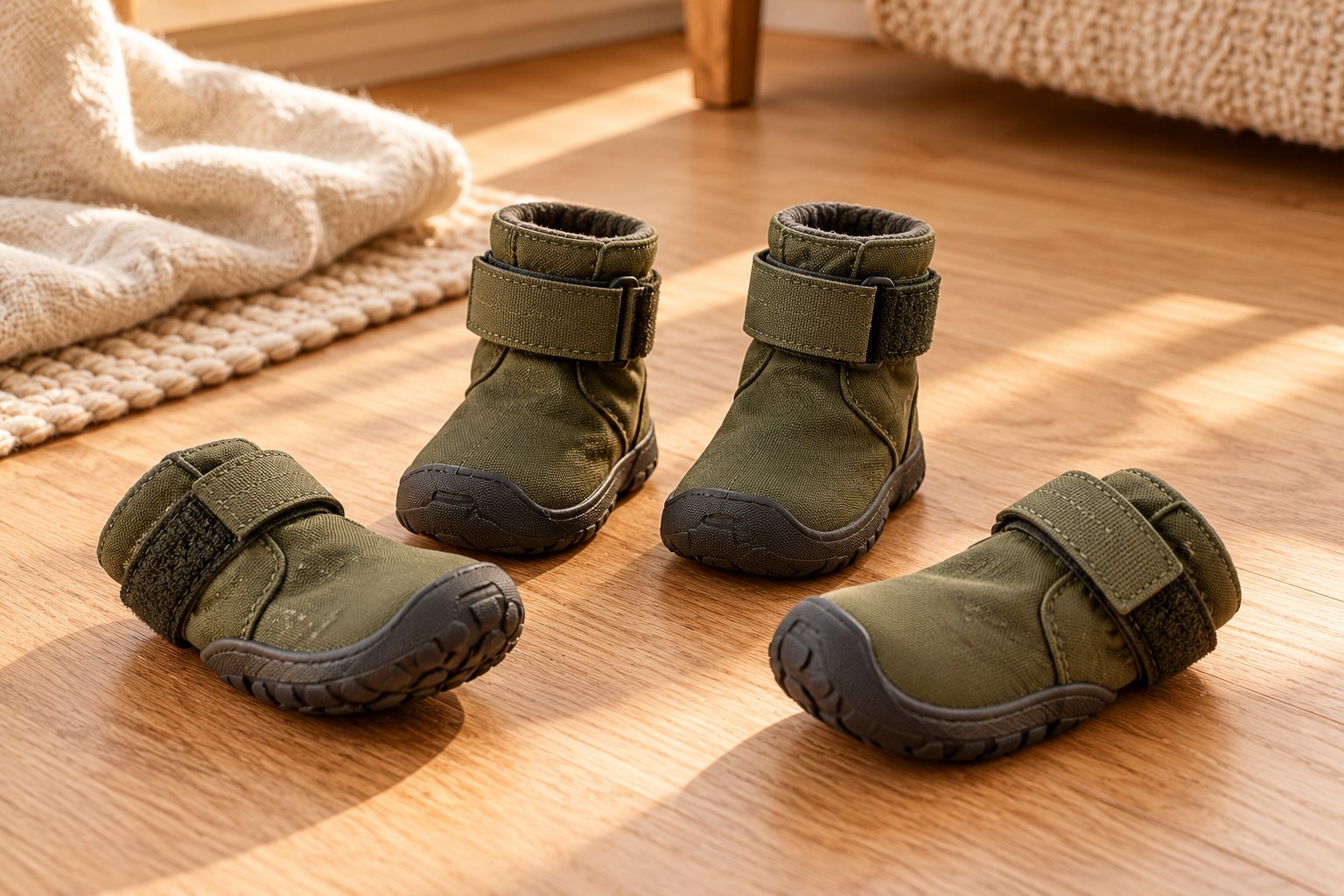
A boot sole mediates between the paw and the ground. Its stiffness, thickness, and tread affect how the boot bends and how clearly the dog can place the foot. A heavily lugged sole may look capable but feel bulky on ordinary pavement. A thin flexible covering may suit brief surface protection yet wear quickly on rough paths.
Choose for the actual route, and remember that boots do not make unsuitable weather or terrain automatically safe.
Match tread to the surface
Deep tread can hold mud and gravel, adding weight or changing contact with the ground. A flatter pattern may be easier to inspect but offer limited purchase on some surfaces. No tread guarantees grip on ice, algae, polished wet tile, or loose stones. Look at the maker’s intended use and treat the first outing as a short supervised trial. If the dog hesitates or slips, choose a different route rather than assuming more time in the same boot will solve the problem.
Feel how the sole bends
Bend the boot gently at the point where the paw naturally flexes. A stiff sole may resist folding, while an overly soft sole can bunch or wear through. Compare flexibility with the size of the foot: the same thickness that feels modest under a large dog may be substantial under a tiny one. Inspect the transition between sole and upper, where repeated bending concentrates stress. A rigid seam at that junction can matter as much as the rubber compound itself.
Check the hidden interior
Turn the boot as far as its design allows and inspect seams, lining edges, and any raised attachment points. Debris inside a boot can create friction even when the sole is appropriate outside. Brush out small stones and check for a folded lining before putting it on. A hypothetical sandy path may require more frequent interior checks than a clean paved route. Do not add an unapproved thick insert simply to fill a loose boot; it changes interior volume and can make pressure uneven.
Consider heat and moisture carefully
Some boots are marketed for hot or cold surfaces, but their materials have limits and wearing them changes ventilation. Follow the stated use conditions and monitor the dog closely. Schedule walks for suitable conditions and choose comfortable routes rather than relying on footwear to permit a prolonged outing on harsh ground. Remove damp boots after use and dry them fully. If the dog has an injury, persistent discomfort, or a medical reason for footwear, ask a veterinarian which construction is appropriate.
Use wear as route feedback
Inspect the tread, toe, and side seams after each early outing. Uneven wear may show rotation, dragging, or a mismatch between the boot and gait, rather than simply proving that the route is rough. Check fit first and seek professional advice for an unusual movement pattern. Replace a boot with a split sole or failed closure; adhesive repairs may not restore predictable behavior. If you alternate pavement and trails, two lighter-purpose options can be more manageable than one oversized all-terrain design.
For our approach to product claims and illustrations, see the Editorial Policy.