Stainless steel describes a material, not a finished bowl. Two bowls with similar capacity can behave differently when a dog noses the edge or a cat pushes a portion against the side. The useful comparison starts with the complete object: its rim, base, wall profile, removable parts, and cleaning instructions.
A good everyday bowl should fit both the animal's access needs and the household's washing routine. A polished surface is pleasant, but it cannot compensate for a narrow opening or a rubber ring that traps water underneath.
Look underneath before comparing finishes
Turn the bowl over in the product photographs, or inspect it in person. A continuous metal base is simple to wipe, while a rolled underside can create a small channel. Neither construction is automatically unsuitable, but channels need access for a brush and a place to drain.
Check how the nonslip element attaches. A removable ring lets you wash and dry the hidden contact area. A bonded pad reduces loose parts but leaves fewer options if its edge lifts. Replacement rings are particularly useful when the metal bowl is likely to outlast the grip material.
Match the geometry to the portion
Capacity labels usually describe volume near the rim. They do not tell you how much working room remains around an ordinary serving. Pour the usual measured portion into a bowl you already own and note how high it sits. Use that height, alongside diameter, as a shopping reference.
A wide bowl with gently sloped walls offers space to approach from several angles. A deeper bowl contains movement more effectively but requires the animal to reach farther down. For a hypothetical small dog using 150 millilitres of dry food, a stated 150-millilitre bowl would leave almost no margin for movement.
Test stability on the actual floor
A heavy bowl can still slide on smooth tile. A light bowl can stay in place if its footprint and grip suit the surface. Test a candidate empty and partly filled by applying a gentle sideways push near the rim. Observe both sliding and tipping; these are different problems.
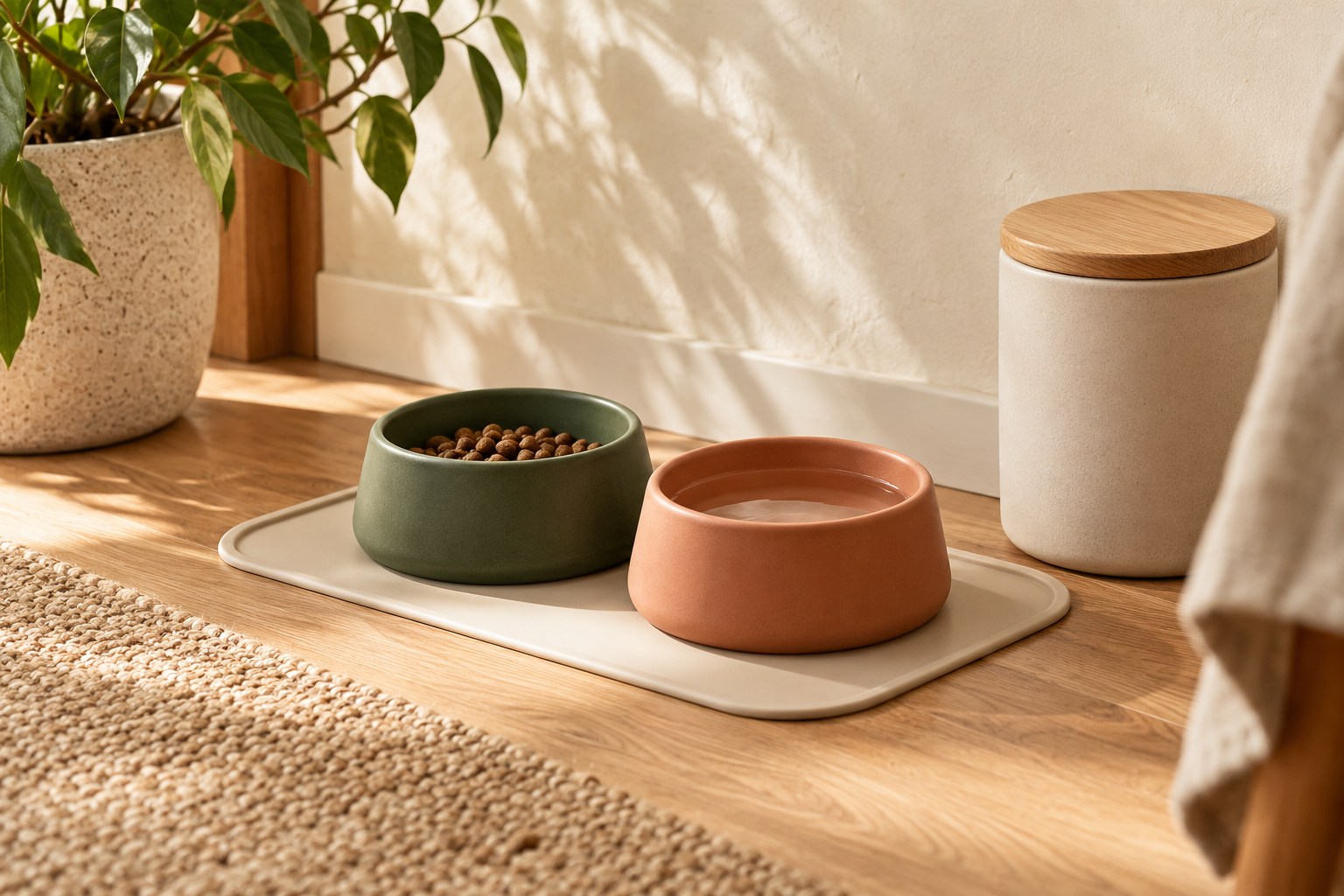
If a mat is involved, test the pair together. A soft, thick mat may make a narrow base rock. Avoid compensating for unstable geometry by wedging the bowl against furniture, because that can make access and cleaning awkward.
Make cleaning a buying criterion
Read the care instructions before assuming every component can enter a dishwasher. Metal, decorative coatings, silicone rings, and attached labels may have different requirements. Choose a bowl whose parts you can separate without excessive force.
After washing, inspect the rim by touch as well as sight. A smooth, accessible edge is easier to keep clean than an elaborate folded detail. Dry the underside before replacing a grip ring, and replace any component that becomes damaged or impossible to clean properly.
For our approach to product claims and illustrations, see the Editorial Policy.